LinkedIn’s 121% ROAS: Breakthrough or Cherry-Picked Metric?

Written by Elias Oender
October 16, 2026 4 min read
The quick answer
LinkedIn's claim of a 121% ROAS in B2B marketing has sparked debate. While impressive, the metric may be cherry-picked or skewed. Performance marketers should focus on incrementality and scalable strategies rather than chasing outlier results.
LinkedIn’s 121% ROAS: Breakthrough or Cherry-Picked Metric?
LinkedIn recently announced a 121% ROAS in B2B marketing, sparking both excitement and skepticism. While the number is impressive, performance marketers know better than to take platform claims at face value. Here’s what you need to know before you reshare that headline.
What does LinkedIn’s 121% ROAS actually mean?
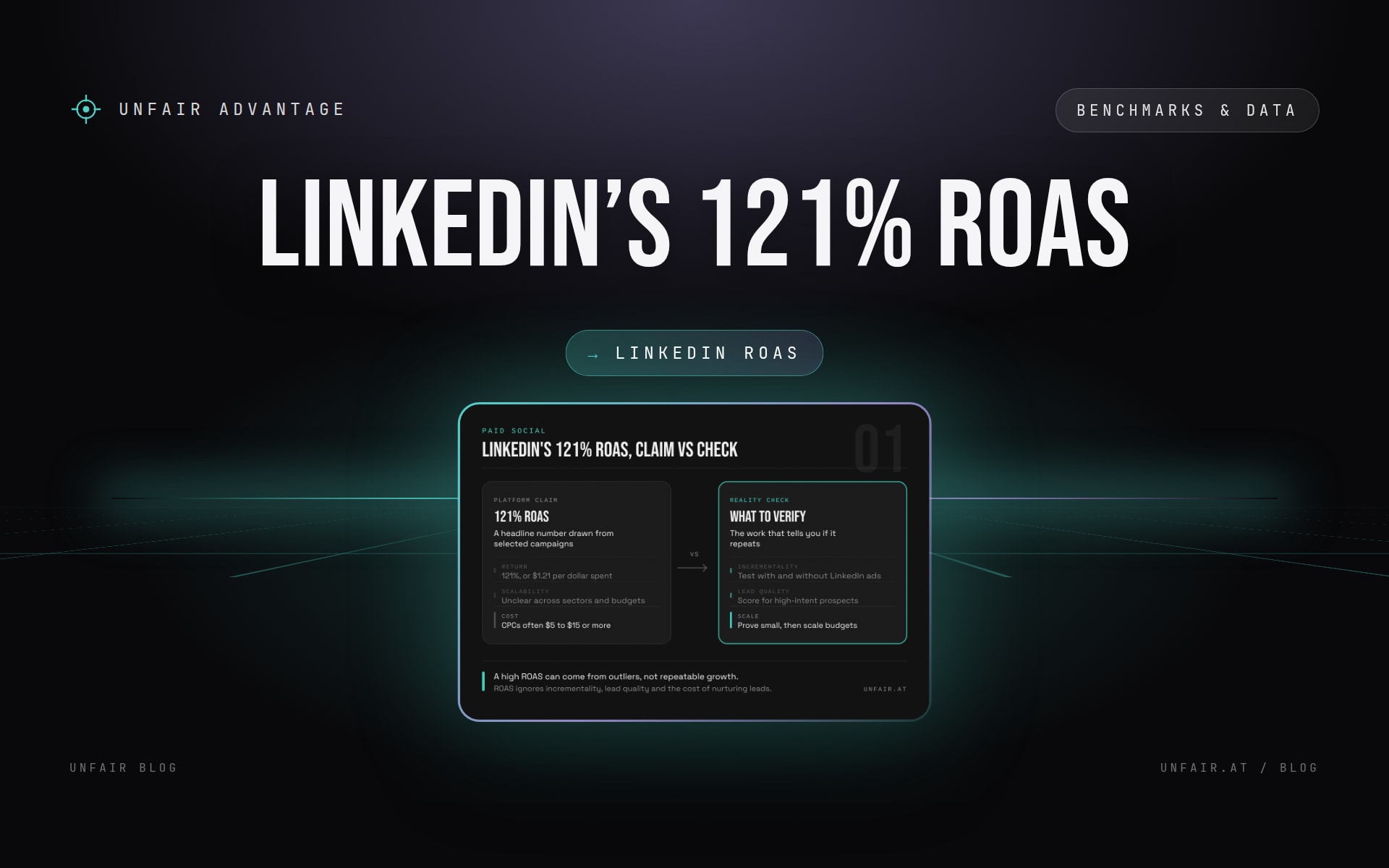
ROAS, or Return on Ad Spend, measures the revenue generated for every dollar spent on advertising. A 121% ROAS suggests that for every dollar spent, LinkedIn ads generated $1.21 in revenue. But here’s the catch: ROAS doesn’t account for incrementality or scalability. As covered here, this metric might be skewed by high-value outliers or cherry-picked campaigns.
For example, imagine a campaign targeting CEOs of Fortune 500 companies. A single conversion from this audience could drive a massive ROAS, but replicating this success across smaller businesses or diverse industries becomes a challenge. Platforms love to highlight these outliers because they make for great headlines, but they don’t always reflect the average advertiser’s experience.
Is LinkedIn’s ROAS scalable or just luck?
Scalability is the gold standard in performance marketing. While LinkedIn’s 121% ROAS sounds groundbreaking, it’s unclear if this result is replicable across industries or budgets. Platforms often highlight outlier campaigns to attract advertisers, but one report notes that LinkedIn’s performance varies widely across sectors.
Consider this: a SaaS company targeting tech startups might see a high ROAS, while a manufacturing firm aiming for mid-level managers could struggle to break even. The platform’s effectiveness often depends on the audience’s purchasing power, industry dynamics, and even the type of product being sold. Without transparency on how LinkedIn calculates this metric, it’s hard to assess its true scalability.
Why ROAS alone doesn’t tell the full story
ROAS is an incomplete metric for B2B marketing. It ignores customer lifetime value, lead quality, and the incremental impact of campaigns. A high ROAS might mean you’re overspending on low-intent leads or targeting existing customers who would have converted anyway. For instance, a campaign that drives conversions from customers already in your pipeline might inflate your ROAS without actually growing your business.
Moreover, ROAS doesn’t account for the time and resources required to nurture leads into paying customers. A high ROAS might look great on paper, but if those leads take months to convert or require extensive sales efforts, the actual ROI could be far lower. For a deeper dive, check out why your ROAS number lies.
What performance marketers should focus on instead
Instead of chasing vanity metrics like ROAS, performance marketers should focus on incrementality and scalability. Here’s how:
- Test incrementality: Compare results with and without LinkedIn ads to measure true lift. For example, run a controlled experiment where you pause LinkedIn ads in specific regions and measure the impact on pipeline growth.
- Track lead quality: Focus on high-intent leads that drive long-term revenue. Use lead scoring to identify which LinkedIn campaigns are delivering the most valuable prospects.
- Optimize for scale: Ensure campaigns can be replicated across larger budgets and audiences. Start small, prove the concept, and then scale intelligently.
The hidden costs of LinkedIn advertising
While LinkedIn’s 121% ROAS might look attractive, it’s worth considering the platform’s often steep costs. LinkedIn ads are notoriously expensive, with CPCs frequently ranging from $5 to $15 or more. For many businesses, especially those with tight margins or longer sales cycles, these costs can quickly erode the perceived benefits of a high ROAS.
Additionally, LinkedIn’s targeting options, while robust, can sometimes lead to overspending. Narrowing your audience too much can drive up costs, while broadening it too much can dilute campaign effectiveness. Striking the right balance requires careful testing and ongoing optimization.
How to evaluate LinkedIn’s potential for your business
Before jumping on the LinkedIn bandwagon, ask yourself these questions:
- Does your audience actively use LinkedIn? If your target market isn’t active on the platform, you’re better off investing elsewhere.
- Are you prepared to invest in creative assets? LinkedIn campaigns often require high-quality, professional content to resonate with its audience.
- Do you have the patience for a longer sales cycle? LinkedIn leads often take longer to convert, so ensure your sales team is equipped to nurture them effectively.
The verdict: LinkedIn’s ROAS is impressive, but incomplete
LinkedIn’s 121% ROAS is a headline-grabber, but it’s not the full story. Performance marketers need to dig deeper into incrementality and scalability to build campaigns that deliver consistent, measurable results. Run a free scan to see where your marketing leaks.
For campaigns that move the needle, check out our lead generation service. We focus on scalable strategies that turn traffic into leads, not just clicks.