Wanderin: The Best Places Near You, With Real Prices

Written by Elias Oender
Our own product 3 min read wanderin.top ↗
The short version
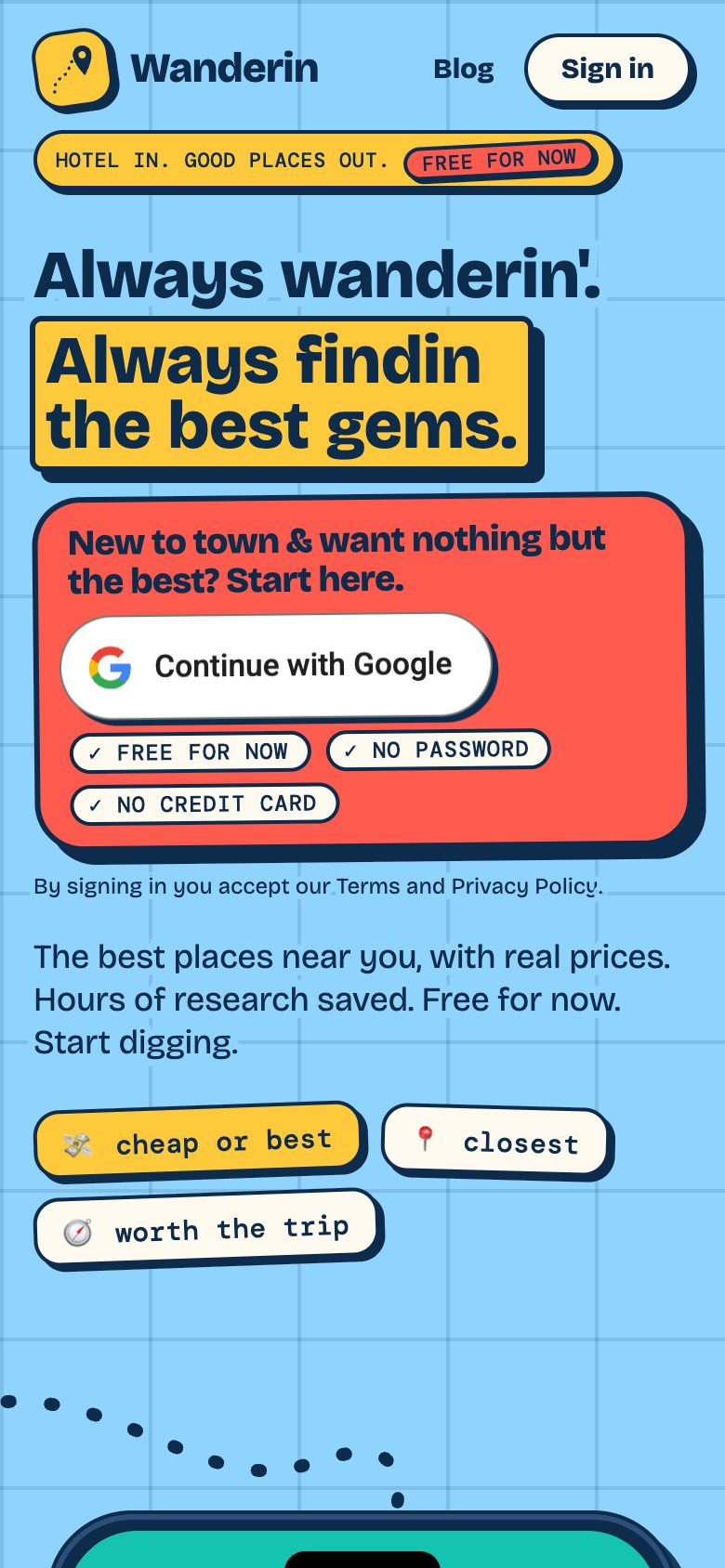
Wanderin is the product we built for the first hour in a new city: type where you are and what you want, and it returns the best-rated places nearby with real prices. It reads websites and reviews for the prices nobody posts, an AI judge picks the amount that fits the request, and the list ranks four ways: cheap, best, closest and worth the trip. Built and run by Unfair Advantage Marketing, live at wanderin.top.
The mission
You check in to a hotel, you need a barber, and the next hour disappears into map tabs, sponsored top ten lists and reviews that never say what anything costs. Wanderin exists to give that hour back. The mission: type where you are and what you want, and get the best places nearby with real prices, in the words of its own blog, before TikTokers find them. Wanderin is our own product, built and run by Unfair Advantage Marketing and live at wanderin.top.
The solution
We built one search that does the reading for you and ranks the answer four ways: cheap, best, closest and worth the trip.
A star bar that protects the top of the list
Every search starts strict, at 4.8 stars within 500 metres, and fills a list of 15 places. Cheap steps down to 4.6 stars before it walks further out, and best of the best holds 4.8 and stays within 2 km. A Bayesian average keeps the ranking honest: a 4.9 from six reviews does not beat a 4.8 from four hundred.
Real prices, found and converted
The stars are easy. The prices hide on business websites and in the middle of review text. Wanderin reads both, an AI judge picks the amount that fits the request, and every amount lands in the local currency, so 12 USD never outranks 120,000 IDR. Finished lists show only prices the evidence carries, and cheap mode lists priced places alone.
Worth the trip, measured on real landmarks
The fourth mode answers a different question: what deserves the detour? A formula weighs the rating, the review volume against the area around it and the type of place, with no AI in the ranking. We measured it on 59 known landmarks in four cities, tuned it on Canggu and Lisbon, and tested it untouched on Vienna and Kyoto.
A launch built to spread
Sign-up is one Google click with no password and no credit card. Every list can be shared by link with its own preview image, a city by city blog feeds new readers into the search, and tracking runs only after consent.
Spend capped from the first search
Every paid call sits behind a budget cap and a repeat search comes out of the cache. The guards come straight from Force, our lead engine, where they already had to hold under real load.
The result
A live product, open to anyone with a Google account and free for now: the best places near you, real prices next to them and hours of research saved.
What you can learn from it
Four lessons come from putting our own money behind our own product.
Sell the answer and do the reading yourself
Nobody wants forty reviews. They want a barber. The product that does the reading and hands over a short list with a price beside each name wins the first hour in a new city, and the same logic holds for any business that sells to busy people.
Let code decide what code can decide
The worth the trip ranking is a formula, and the AI only judges which price on a page fits the request. Code gives the same answer every time and costs next to nothing, so the model is saved for the calls that take judgment.
Measure a ranking on answers you already know
A ranking feels right until someone checks it. Known landmarks gave a test sheet, and two cities held back from tuning showed whether the formula works beyond the places it was built on.
Cap the spend before the first user
A product that spends money on every search needs its limits in place before the launch. A cap costs an afternoon. Finding out without one costs a month’s budget.
At Unfair Advantage Marketing, we bring that discipline to every account we run. Ad Infinitum, an engine of 120+ agents and rules, steers client budgets live toward what earns. To see where the spend guards were born, read the Force case.
Want a product or an engine like this working for your business? Let’s talk.