Why the Cold Email AI Agent Replaced the Template Playbook

Written by Elias Oender
November 10, 2026 6 min read
The quick answer
A modern cold email ai agent replaces mechanical templates with real outside-in research. Instead of blasting generic mail-merge fields, an autonomous outreach system reads how a prospect actually speaks before drafting an opening line. This shifts outbound prospecting from annoying digital noise to relevant, native conversations that bypass buyer fatigue.
Is your outbound strategy quietly getting ignored?
Every morning, thousands of executives open their inboxes and delete dozen upon dozen of identical cold pitches before their second sip of coffee. You know the exact format. It starts with an awkward compliment about their recent promotion, stumbles through a canned transition, and ends with an aggressive request to grab coffee. It feels mechanical because it is. For years, the industry pretended that swapping out a first-name tag and a company name counted as genuine personalization. It never did, and today buyers smell the template from a mile away.
Traditional mail-merge sequences have run directly into a brick wall. Mailbox providers continue tightening their defenses, spam filters catch rigid formulas instantly, and executive attention spans have bottomed out. Blasting larger lists with static templates simply burns through your domain reputation faster. When everyone has access to the exact same scrapers and sequencing tools, the playbook stops working.
This is why relying on disconnected software fails so quickly. As we often discuss when examining why marketing tools fail without context, software without contextual insight merely accelerates bad habits. If your outbound strategy relies on brute-force volume, you are paying high subscription fees to send digital flyers directly into junk folders.
What is marketing automation when templates stop working?
Traditional marketing automation was built for a simpler internet. You uploaded a CSV, mapped five columns to bracketed fields, set a timer, and hoped for a response. That approach worked when inboxes were quiet and novelty was high. Today, buyer fatigue has turned generic sequences into pure liabilities. When your outreach looks like everyone else’s, prospects do not just hit delete. They mark you as spam, permanently damaging your sender profile.
The industry is waking up to this reality. In recent industry rundowns like the Snov.io guide to cold email AI tools, the focus has decisively shifted away from basic scheduling utilities toward systems capable of contextual adaptation. The gap between basic mail-merges and genuine research is where deals are either won or lost.
When we look at outbound marketing, we do not see a game of volume. We see an intellectual match. The winner is whoever arrives with acute contextual relevance before anyone else wakes up. If an email fails to prove that you understand the recipient’s daily world, no clever subject line will save it.
How does a cold email ai agent change the prospecting game?
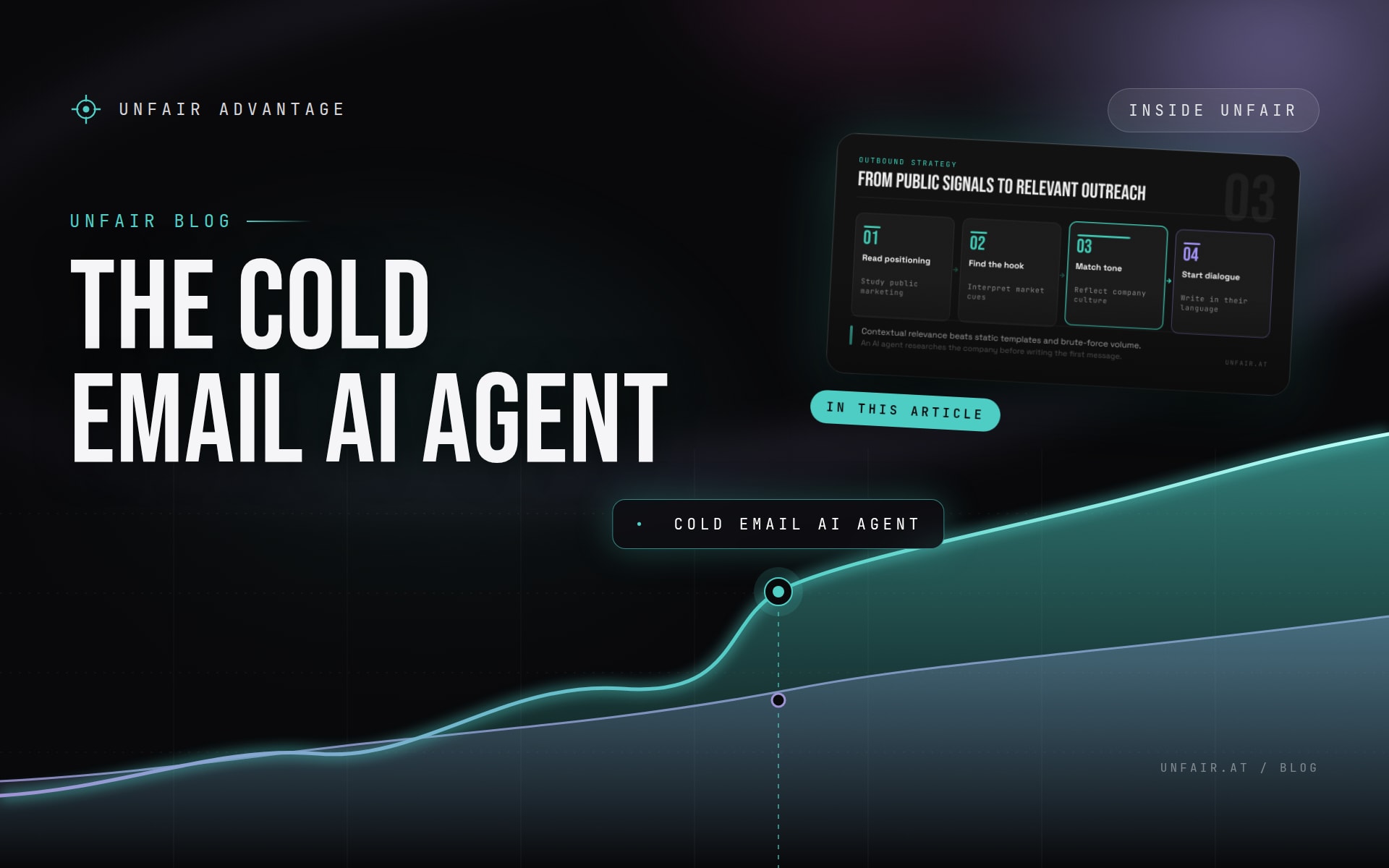
A true cold email ai agent does not treat personalization like a spreadsheet exercise. Instead of blindly filling blank slots in a pre-written paragraph, an autonomous agent operates like a relentless, senior research analyst. It evaluates public corporate footprints, tracks strategic changes, and digests the exact communication style a business presents to the world before a single sentence is typed.
This fundamentally alters how outbound pipeline develops. As highlighted in the Foxreach guide for AI agents, modern outreach is evolving into autonomous agentic workflows that act as persistent operators rather than passive text templates. The agent handles the cognitive heavy lifting that human teams rarely have time to execute at scale.
- Evaluates external positioning and marketing vernacular from the outside in.
- Translates public market signals into bespoke conversational hooks.
- Adapts message cadence and tone to reflect company culture.
- Initiates dialogue without sounding like a robotic mail-merge blast.
When outreach speaks a company’s internal dialect, the psychological barrier drops immediately. The recipient does not feel pitched. They feel recognized.
How we built Force to solve outbound prospecting
We refused to accept that outbound had to mean babysitting repetitive email flows. That is why Elias built Force. Force is an outreach engine that finds the right companies, reads their marketing from the outside and writes the first message in their own language.
No, we will not show you the engine. Yes, you can watch it drive. The entire concept behind Force comes down to giving an account an unfair, autonomous edge. When an outreach system can read an organization’s public vernacular and synthesize that positioning in moments, it bypasses weeks of human trial and error. While conventional growth teams waste afternoons debating copywriting frameworks, Force is already starting relevant conversations with key decision makers while you sleep.
We run this inside our own stack every single day, and the difference between static software and autonomous execution could not be starker. When you see how legacy stacks struggle, as explored in our breakdown of why marketing tools don’t work alone, you realize that winning requires bespoke, integrated leverage. Force operates quietly behind the scenes, turning digital outreach into a predictable driver of pipeline without bloated teams or tedious manual research.
Why a dedicated senior operator beats an agency army
The traditional response to flatlining cold outreach is hiring more heads. Founders bring in an agency, which delegates the work to junior copywriters, who promptly download the same worn-out templates from LinkedIn influencers. You end up paying hefty monthly retainers for account managers whose primary job is explaining away mediocre response rates on monthly status calls.
Headcount is not leverage. In fact, layering more people onto broken systems only multiplies miscommunication. Elias runs our operations as a dedicated senior partner, using intelligent engines like Force to outmaneuver multi-layered teams with precision and speed. A single senior operator running dedicated AI engines can outthink, outwrite, and outpace an entire floor of junior coordinators.
When Elias handles an account, the strategy is sharp, the systems run around the clock, and the accountability rests with one experienced mind. You avoid the bloated overhead, the junior learning curves, and the bureaucratic delays. The future belongs to lean, highly specialized operators who command autonomous machines to produce results in a fraction of the time.
How to do b2b lead generation without burning domain reputation
Protecting your outbound equity requires an absolute commitment to quality. The moment you treat outreach as a generic numbers game, mailbox filters categorize your domain as promotional trash. Recovering from a burned reputation takes months of tedious remediation that stalls your revenue growth.
To scale without setting off alarm bells, your prospecting must look, sound, and read entirely unique to every recipient. An intelligent cold email ai agent ensures that every outgoing touchpoint reflects true bespoke context. Because the language is drawn from the target’s own outward-facing vernacular, the pitch feels organic, engaging, and entirely devoid of spam signatures.
Early movers in this space are already compounding their pipeline advantages, while laggards wonder why their open rates are plummeting. The market does not wait for organizations to catch up to technical reality. You either modernize how you approach executive inboxes, or you accept becoming invisible.
See the engine drive on your own pipeline
Outbound marketing is undergoing its largest structural transition in decades. You can continue updating tired spreadsheet formulas and hoping prospects overlook the obvious mail-merge tags, or you can arm your business with autonomous systems that initiate native, highly relevant conversations every single day.
Force eliminates the friction of prospecting by evaluating target companies from the outside and drafting pitches that fit their exact wavelength. If you want to stop guessing what will make prospects respond and see how an autonomous outbound engine transforms your growth strategy, book a call to watch our systems work in real time.