Google Ads' Smart Bidding Update: Is Your $5 CPA Now $6?

Written by Elias Oender
October 20, 2026 7 min read
The quick answer
Google Ads' Smart Bidding update in 2026 has increased costs for budget-limited campaigns, potentially making a $5 CPA more expensive. While Google claims this improves performance, it raises questions about algorithmic transparency and whether this is a push toward higher spend thresholds. Marketers need to rethink campaign strategies to adapt.
Is Google Ads’ Smart Bidding Update a $5 CPA Killer?
Google Ads’ Smart Bidding update in 2026 has marketers scratching their heads. The headline change? A $5 CPA might now cost more. Is this Google nudging advertisers toward higher budgets, or just another layer of algorithmic opacity? The update feels like walking into your favorite coffee shop and finding out your usual latte now costs double, but hey, it’s ‘better.‘
What Actually Changed in the Smart Bidding Update?
The update tweaks how Smart Bidding handles budget-limited campaigns. Where a $5 CPA once felt achievable, advertisers now report bids creeping higher. Google claims this improves performance, but the numbers suggest otherwise. As one report notes, bid suppression, once a feature of Smart Bidding, has been dialed back, effectively raising costs.
The key mechanism here is the algorithm’s prioritization of conversion volume over cost efficiency. In simpler terms, if your budget is tight, Smart Bidding now sees your campaign as less profitable for Google and adjusts accordingly. Imagine walking into a store with a $20 bill and being told, ‘Sorry, we only accept $50s now.’ That’s the vibe.
Here’s a breakdown of what’s happening under the hood:
- Bid Suppression Reduction: Previously, Smart Bidding would suppress bids on less profitable clicks. Now, it’s less aggressive, leading to higher CPAs.
- Volume Over Efficiency: The algorithm now prioritizes driving more conversions, even if it means higher costs per conversion.
- Budget Sensitivity: Tight budgets are penalized, as the algorithm deems them less valuable to Google’s bottom line.
It’s like Google looked at your campaign and said, ‘Nice try, but pay up.’
For example, one advertiser running a local campaign with a $20 daily budget saw their CPA jump from $5 to $7 within a week of the update. They dug into the data and found that while conversion volume increased slightly, the cost per conversion skyrocketed. The algorithm was chasing volume at the expense of efficiency, effectively squeezing their budget dry.
Why Is This Happening?
Simple: incentives. Google’s revenue model thrives on higher ad spend. By nudging advertisers toward loftier budgets, Smart Bidding aligns with Google’s bottom line. As Google’s own documentation puts it, the algorithm ‘learns’ to optimize for conversions, but only within the bounds of your budget. If your budget is tight, the algorithm might decide you’re not worth the effort.
But let’s not villainize Google just yet. The platform operates in a competitive ad space, and its algorithms are designed to maximize ROI, for itself. The real question is whether this update benefits advertisers in the long run. Spoiler: it doesn’t, unless you’re spending big.
Here’s the kicker: Google’s AI isn’t optimizing for your ROI; it’s optimizing for its own. And when those two things clash, guess who wins? Hint: it’s not you.
Consider this: Google’s ad revenue grew by 8% YoY in Q1 2026, driven largely by higher ad spend. Coincidence? Probably not. The update is a strategic move to boost revenue, and advertisers are feeling the pinch.
Is Smart Bidding Still Worth It?
For advertisers flush with cash, yes. For the rest? Maybe not. Budget-limited campaigns now face higher CPAs, making Smart Bidding less appealing for smaller advertisers. If your goal is a $5 CPA, you might find yourself paying $6, or more. The solution? Manual bidding or hybrid strategies that blend automation with human oversight.
Here’s a quick breakdown:
- Pros of Smart Bidding: Hands-off, scales well with larger budgets, leverages Google’s AI.
- Cons: Less control, higher costs for smaller budgets, algorithmic opacity.
If you’re running a small campaign, Smart Bidding might now feel like renting a Ferrari to drive to the grocery store. Overkill, and expensive.
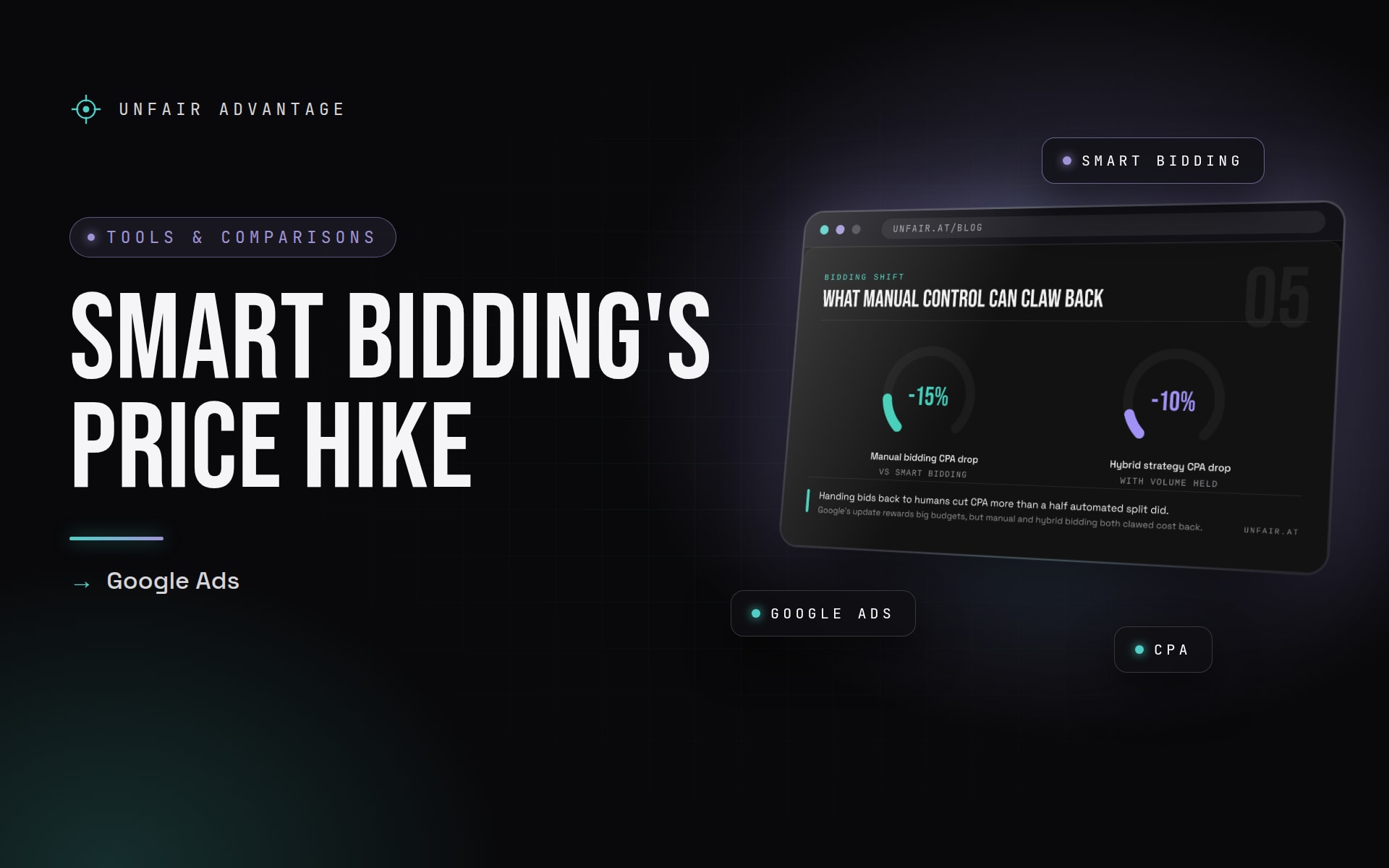
Consider this: one advertiser running a niche campaign switched to manual bidding and saw a 15% drop in CPA compared to Smart Bidding. The catch? It required weekly adjustments and a spreadsheet that looked like a rainbow exploded. But hey, if it saves you money, it’s worth the effort.
Another advertiser running a $500/day campaign found Smart Bidding still effective, but only after increasing their budget by 20%. The update rewards those who spend more, leaving smaller advertisers in the dust.
What’s the Alternative?
Manual bidding offers more control, but it’s labor-intensive. Hybrid strategies, like using Smart Bidding for high-volume campaigns and manual bids for niche ones, can strike a balance. Another option: run a free scan to identify inefficiencies in your current setup.
Here’s a deeper look at alternatives:
- Manual Bidding: Full control over bids, but requires constant monitoring and tweaking. Think of it as driving stick shift.
- Hybrid Strategies: Use Smart Bidding for broad campaigns and manual bidding for niche ones. This way, you get the best of both worlds.
- Third-Party Tools: Platforms like Optmyzr or WordStream can help automate manual bidding, reducing the workload.
It’s like choosing between a self-driving car and a manual transmission. Both have their perks, but only one lets you take the wheel.
For example, one advertiser used a hybrid strategy to balance their $1,000/day budget. They allocated 70% to Smart Bidding for broad campaigns and 30% to manual bidding for niche keywords. The result? A 10% reduction in CPA while maintaining conversion volume.
How to Adapt to the New Normal
First, accept that $5 CPAs might be history. Second, focus on incrementality testing to isolate what’s working. Third, refine your audience targeting to reduce wasted spend. As this analysis suggests, adapting to the update requires a mix of strategy and vigilance.
Here’s a quick action plan:
- Audit Your Campaigns: Identify which campaigns are hit hardest by the update. Look for spikes in CPA or drops in conversion volume.
- Test Incrementality: Measure the true impact of your ads, not just the vanity metrics. Use tools like Google’s Campaign Experiments to isolate variables.
- Optimize Targeting: Narrow your audience to reduce wasted impressions. Use custom audiences or lookalike audiences to focus on high-intent users.
Think of it like pruning a tree. Cut the dead branches to let the healthy ones thrive.
For example, one advertiser ran an incrementality test and discovered that 30% of their conversions were happening organically, even without ads. By reallocating their budget toward high-intent users, they reduced CPA by 12%.
Is This Google’s Way of Pushing Higher Spend?
Probably. The update feels like a nudge, or a shove, toward higher budgets. As WeVenture notes, ‘Smart Bidding now favors advertisers willing to spend more.’ Whether this is a bug or a feature depends on your perspective, and your wallet.
But let’s be real: Google isn’t running a charity. Its algorithms are designed to maximize revenue, and if that means squeezing smaller advertisers, so be it. The question is, how do you respond?
Here’s the thing: Google’s incentives are clear. It wants you to spend more. Your job is to make sure you’re spending smarter, not just more.
For example, one advertiser increased their budget by 25% but also tightened their targeting to focus on high-ROI audiences. The result? A 15% increase in conversions without blowing up their CPA.
What’s Next?
Marketers need to rethink their Google Ads strategies. The days of set-it-and-forget-it campaigns are over. Instead, focus on continuous optimization, incremental testing, and a healthy dose of skepticism. And if you’re unsure where to start, book a call.
This is the job we run: Ad Optimization takes the guesswork out of Google Ads, offering monthly optimization that adjusts to changes like Smart Bidding. Because when Google moves the goalposts, you need a senior operator in your corner.
Here’s the bottom line: the Smart Bidding update isn’t the end of the world, but it’s a wake-up call. Adapt, optimize, and don’t let the algorithm outsmart you.
Pro tip: Keep an eye on your campaigns. If you see CPAs creeping up, it’s time to pivot. Because in the world of Google Ads, standing still is the fastest way to fall behind.
For example, one advertiser noticed their CPA creeping up by 10% over two weeks. Instead of panicking, they ran a quick audit, identified underperforming keywords, and reallocated their budget. The result? CPA stabilized, and they avoided a budget blowout.