How to Hire a Klaviyo Expert: Flows, Attribution, and Why Teams Fail

Written by Elias Oender
November 12, 2026 10 min read
The quick answer
A Klaviyo expert designs lifecycle architecture, behavioral segmentation, and honest incrementality tracking rather than sending pretty drag-and-drop newsletters. When hiring, vet whether they understand cross-channel attribution and multi-touch cannibalization. Agency retainers usually buy juniors padded with project manager fees; hiring one dedicated senior operator who pairs deep execution with autonomous AI systems delivers higher accountability and lower total acquisition costs.
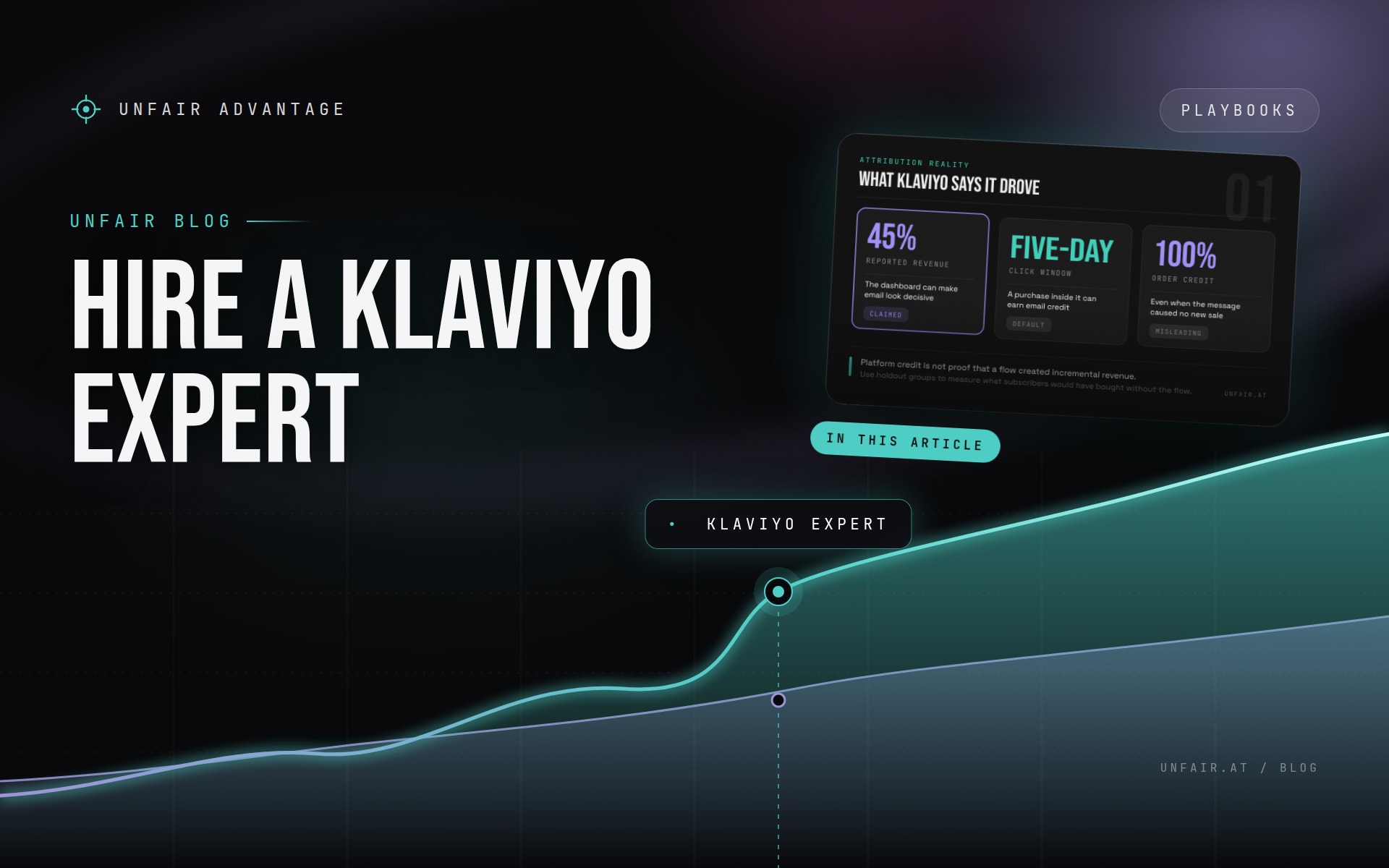
Every brand looking to hire a Klaviyo expert has seen the same dashboard mirage: a clean graph claiming email accounts for 45% of total store revenue, while total bottom-line bank deposits stay completely flat. Platforms are built to claim credit. Most operators are happy to let them. If you want to find the best partner for lifecycle revenue, you have to separate cosmetic template builders from engineers who build automated customer retention.
What is marketing attribution when Klaviyo claims all the revenue?
The default attribution setting in Klaviyo is famously generous. By default, Klaviyo credits an email or SMS for any transaction that happens within a five-day click window, or worse, open windows on platforms affected by Apple Mail Privacy Protection. If a customer was already navigating to your checkout to purchase a restock, and an abandoned cart email hits their inbox sixty seconds before they enter their credit card, Klaviyo claims 100% of that order. The software pats itself on the back. The agency sends an invoice. In reality, that message caused zero incremental revenue.
Attribution is the mathematical assignment of credit across touchpoints. When a consultant or agency points to the platform’s self-reported dashboard to justify their fee, you are being sold soft metrics. If an automated flow simply captures sales that paid search or organic brand equity already earned, your email engine is not driving growth. It is acting as an expensive toll booth. The reality is that tools fail without incrementality testing, and treating native platform attribution as gospel is how lifecycle budgets get misallocated for years.
Real revenue measurement requires holdout testing and incrementality tracking. In my client work, conversions are logged as hard business actions, like booked calls, verified purchases, and verified leads, versus soft clicks like newsletter signups, with cross-session contacts evaluated deliberately so single automated triggers do not swing an entire growth plan. When you choose an operator, make sure they design true holdout control groups to show what happens when subscribers do not receive a flow. That margin difference is what you are actually buying.
What does a true Klaviyo expert do in the first 90 days?
A mediocre freelancer logs in, redesigns your pop-up with a brand font, and schedules four weekly discount newsletters. A reliable lifecycle specialist treats your tech stack like an engineering pipeline. The first ninety days should permanently rewire how your customer data flows into revenue.
During onboarding, an expert evaluates technical deliverability before writing a single subject line. They audit your dedicated sending domain, verify your DMARC, DKIM, and SPF protocols, inspect Google Postmaster Tools metrics, and clean unengaged subscribers who drag your inbox placement down. If your emails land in the spam folder or the promotions tab, creative copywriting is irrelevant.
Here is what an authoritative 90-day scope of work looks like:
- Technical Foundation and Deliverability: Sunset sunset segments, purge bots, repair Google and Yahoo inbox compliance, and set up proper suppression logic.
- Core Behavioral Flows: Re-engineer the foundational money-makers: welcome series split by intent, high-intent checkout triggers, predictive browse abandonment, and post-purchase onboarding that drives second purchases without immediate discounts.
- Advanced Segmentation: Build dynamic segments based on purchase frequency, expected order value, customer lifetime value predictive analytics, and zero-party quiz data.
- Incrementality and Attribution Alignment: Establish baseline conversion rates using holdout groups to quantify actual lift over organic store sales.
This diagnostic phase is critical. If your existing setup has invisible tracking leaks, you can run a free scan to evaluate how an AI system assesses your brand presence and measurement clarity from the outside before spending thousands on flow redesigns.
Freelancer, agency, or dedicated senior: how do you compare options?
When brands vet lifecycle talent, they usually weigh three paths: hire a freelance executioner from an open marketplace, engage an email marketing agency, or contract a dedicated senior specialist. Understanding the pricing, rates, and operational tradeoffs prevents expensive hiring mistakes.
+--------------------------------------------------------------------------------+
|                                 THE TALENT SPLIT                               |
|                                                                                |
|   Marketplace Freelancer          Traditional Agency        Dedicated Senior   |
|   [Low Cost / Execution Only]     [High Fee / Junior Team]   [Direct Mastery]  |
|         |                                 |                        |           |
|         v                                 v                        v           |
|   Task execution                  Layers of overhead        Strategic systems  |
|   No systems strategy             Juniors do the work       Deep accountability|
+--------------------------------------------------------------------------------+
Marketplace platforms like the Upwork Klaviyo freelancer directory or Fiverr Pro offer quick task execution. You will find thousands of freelancers with competitive hourly rates. The friction is clear: you must be the strategic architect. If you lack the technical depth to audit database syncs, API webhooks, or incrementality models, managing a junior freelancer turns into a part-time job.
Traditional digital agencies sit at the opposite extreme. You review a glossy proposal, meet a charismatic business development director, and negotiate a retainer starting at five to eight thousand euros a month. Two weeks after signing the contract, you discover the senior strategist was merely a sales asset. Your daily account management is passed to an overworked junior with six months of platform experience, coordinated through an account manager who acts as a translation layer. You are paying for agency overhead, office rent, and multi-layered bureaucracy. For insight into how agencies source talent, look at discussions on the Reddit Klaviyo community, where providers constantly discuss outsourcing fulfillment.
The most effective model is securing a dedicated senior operator who bypasses the agency model entirely. One veteran who runs automated AI execution systems can outmaneuver an entire team of ten agency juniors. You get direct access, deep institutional expertise, and systems running continuously without paying for agency account managers. In my 15+ years in performance marketing, I have managed a peak of EUR 1.2M ad spend in a single month across 72 clients. The single senior operator backed by software is faster, more accountable, and dramatically more capital efficient.
What questions should you ask in an interview to vet for competence?
Do not ask a prospective hire if they know how to build a flow. Anyone who completed a certificate on the Klaviyo Academy can click together a three-step drip sequence. If you want to vet a consultant or agency partner, invite them to an interview and ask questions that expose how they handle edge cases, attribution friction, and data architecture.
- How do you measure incremental lift versus organic store purchases in our flows? If they respond by pointing to Klaviyo’s last-touch attribution dashboard, pass. A trusted partner will discuss control holdout groups, UTM taxonomy, and tracking baseline purchase rates.
- How do you approach segmenting subscribers using Apple Mail Privacy Protection? Apple pre-fetches email pixels, creating artificial open rates near 60% across iOS devices. A qualified specialist explains how to build engagement segments using click metrics, onsite web activity, and purchase history rather than unreliable open rates.
- What is your specific protocol when deliverability dips on Gmail or Yahoo? Look for concrete answers: segment throttling, engaged-subscriber warmups, domain reputation auditing via Google Postmaster Tools, and removing soft bounces before they become hard blocks.
- Who actually does the technical work on our account? If you are talking to an agency or consulting firm, ask who writes the copy, configures the conditional logic, and tracks the analytics. If the answer involves an account manager handing briefs to junior staff, you are buying diluted execution.
- How do you integrate SMS and email to avoid cross-channel cannibalization? Sending an identical promotional email and a text message within an hour burns margin and spikes unsubscribes. They should explain message suppression hierarchies and dynamic branch conditions based on channel responsiveness.
When you request a quote or compare proposals from your shortlist, these diagnostic questions expose whether you are interviewing a technician who follows standard templates or an engineer who understands full-funnel economics. Over-relying on basic checklists is why marketing playbooks fail without context.
Retainers, projects, and pricing: what should your contract look like?
Understanding the commercial structures for Klaviyo talent prevents budget bleed. Engagements generally fall into two models: fixed-scope project audits and recurring monthly retainers. Selecting the right structure depends on where your lifecycle maturity sits.
+--------------------------------------------------------------------------------+
|                       COMMERCIAL STRUCTURE COMPARISON                          |
|                                                                                |
|   Structure         Cost Profile             Best For                          |
|   --------------------------------------------------------------------------   |
|   System Audit      One-off Flat Fee         Diagnosing leaks & architecture   |
|   Turnkey Build     Project Milestone Fee    Launching clean core infrastructure|
|   Growth Retainer   Monthly Flat + Incentive Optimization & continuous testing |
+--------------------------------------------------------------------------------+
A project-based audit and infrastructure build makes sense if your brand already has internal execution hands to manage regular newsletter drops, but your technical flows are broken or non-existent. A typical audit and rebuild should carry a clearly scoped deliverables list: domain alignment, deliverability remediation, and the deployment of core branching flows. Expect a transparent timeline and defined scope without an open-ended bill.
If you require strategic experimentation, automated segmentation refinement, and continuous conversion rate optimization, a monthly retainer is appropriate. Watch out for agencies that tie their retainer fee to total attributed Klaviyo revenue. This fee incentive encourages providers to claim as much credit as possible by lengthening attribution windows and blasting wide customer lists to capture coincidental transactions. Tie retainers to managed scope, rigorous holdout testing, and overall acquisition health. Always negotiate a standard 30-day notice period to maintain operational flexibility.
To see how certified partners position their services, review listings on the official Klaviyo Service Partner Directory or guides on how to hire an email marketing expert. You will find that ROAS numbers can easily distort actual return, which is why lifecycle pricing must focus on incremental margins rather than platform vanity metrics.
What are the critical red flags that tell you to walk away?
Before you sign a contract or commit budget to a new lifecycle partner, scan for operational warning signs. The lifecycle marketing landscape is filled with tactics that look impressive in weekly presentations while actively damaging your long-term customer database.
- Guaranteed Revenue Percentages: If a consultant guarantees that email will drive 40% of your revenue in 60 days, walk away. Reaching that number is trivial if you open attribution windows to 30 days and blast your entire subscriber list with margin-eroding discounts. Real growth protects price integrity.
- No First-Party Data Architecture: If their strategy focuses solely on sending broadcast newsletters rather than capturing zero-party data through quizzes, preference centers, and purchase cadence triggers, they are running a manual broadcast calendar, not an automated retention engine.
- The Agency Vanishing Act: If you interview a seasoned marketing executive but find yourself cc’d on emails with junior specialists and project coordinators within week two, your budget is subsidizing agency overhead rather than driving growth.
- Ignoring Channel Interdependence: Email does not live in an isolated silo. It directly impacts your paid acquisition payback windows. If your specialist never asks about your paid acquisition spend, blended CAC, or customer retention curves, they are optimizing for isolated platform metrics rather than holistic store profitability.
To maintain high conversion efficiency across paid media and lifecycle channels, I run automated systems that transcribe and score public ad libraries, test creative angles systematically, and enforce an algorithmic budget floor so low-performing branches are cut fast. In past engagements, this disciplined cross-channel engineering has delivered an average conversion lift of +127%. Relying on siloed manual adjustments is why marketing tools fail to scale alone.
How to get an unfair advantage from your Klaviyo architecture
Most brands overpay an agency to assign junior staff to drag-and-drop templates, or hire a budget freelancer who cannot read an attribution report. The strategic path forward is to engage one senior operator who pairs deep performance engineering with relentless automated systems.
At Unfair Advantage Marketing, I run marketing systems directly as Elias. As a former lecturer at HSLU and Werbeakademie Wien, I treat lifecycle architecture as a core driver of bottom-line unit economics. Your email and SMS channels should not be a repetitive newsletter calendar. They should operate as an automated pipeline that reduces customer acquisition costs, captures second purchases, and logs verified business events cleanly without vanity metrics.
If you want to stop guessing whether your lifecycle setup actually produces incremental revenue, book a call. We will evaluate your current segmentation, audit your attribution models, and determine the exact operational bottlenecks holding back your profitability. No agency account managers. No inflated team overhead. Just one dedicated senior operator giving your business an unfair advantage.