HubSpot’s Warmly Acquisition: A Leap Toward AI-Driven Intent Data or a False Positive Flood?

Written by Elias Oender
June 23, 2026 7 min read
The quick answer
HubSpot’s acquisition of Warmly aims to integrate AI-driven intent data into CRM, promising person-level insights. However, skepticism remains about false positives and scalability in crowded markets. Marketers must balance excitement with caution to avoid drowning in unreliable predictions.
What is HubSpot’s Acquisition of Warmly All About?
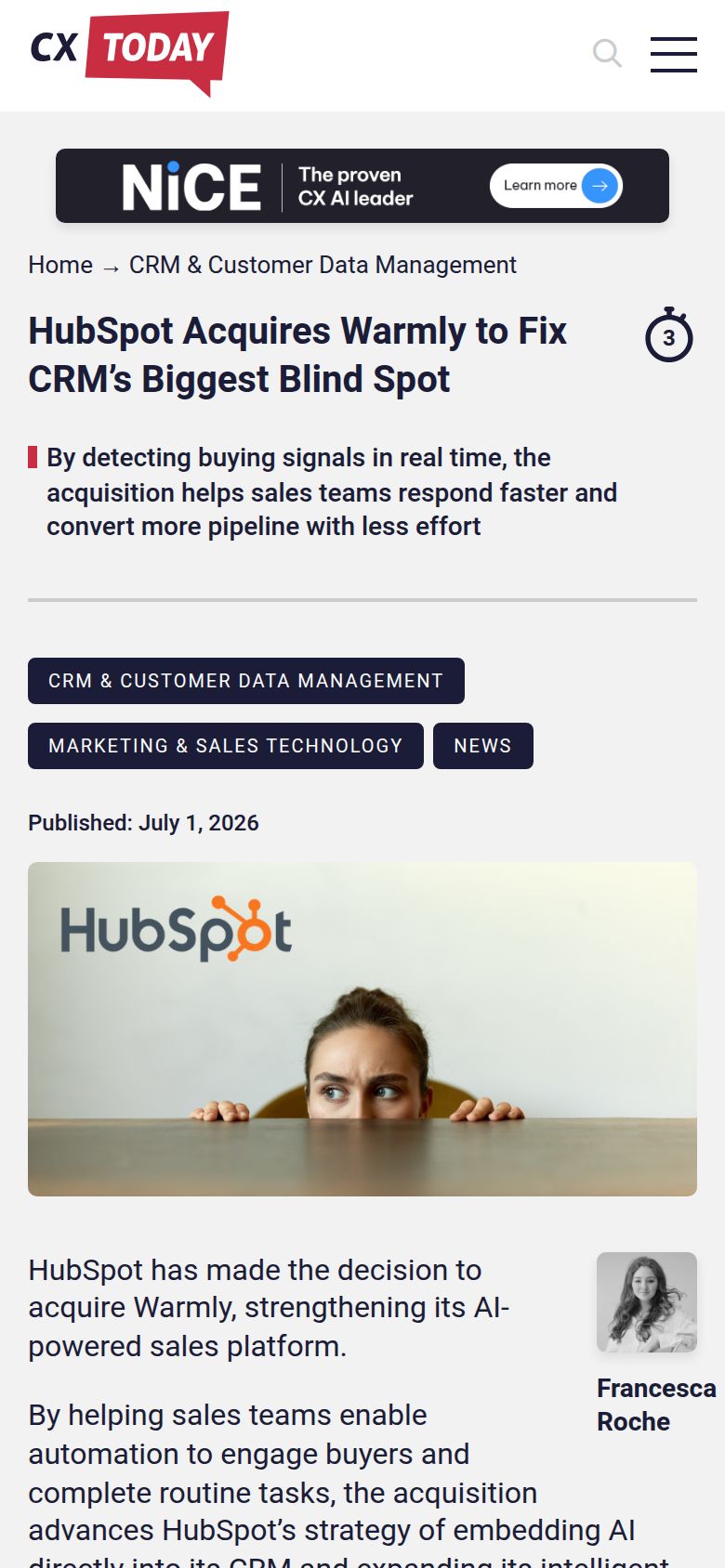
HubSpot’s recent acquisition of Warmly marks a significant pivot toward AI-driven intent data in CRM. As covered here, the deal aims to integrate Warmly’s AI capabilities to predict person-level intent, a long-standing blind spot in CRM systems. This move aligns with HubSpot’s broader strategy to enhance its AI agents and provide more granular insights into customer behavior. Historically, CRM systems have relied on company-level data, which often misses the nuances of individual decision-makers. By incorporating Warmly’s technology, HubSpot aims to bridge this gap and deliver actionable insights at the person level.
Why Is Person-Level Intent Data So Important?
Person-level intent data promises to revolutionize marketing by offering hyper-targeted insights. Instead of broad demographics, marketers can now focus on individual behaviors and needs. For example, one report highlights how Warmly’s technology can identify specific buyer signals, such as website visits or content engagement, to predict purchase intent. This level of detail could significantly improve lead scoring and campaign personalization. Imagine a scenario where a marketing team can identify a potential buyer who has visited their pricing page multiple times and engaged with a product demo video. With person-level intent data, they can tailor their outreach to address this individual’s specific interests and concerns, increasing the likelihood of conversion.
What Are the Challenges of AI-Driven Intent Data?
Despite its potential, AI-driven intent data faces skepticism. False positives remain a major concern, especially in crowded markets where signals can overlap or be misinterpreted. An analysis found that without rigorous validation, AI predictions can lead to wasted resources and missed opportunities. Marketers must balance excitement with caution to avoid drowning in unreliable data. For instance, an AI system might flag a user as a high-intent lead based on their browsing behavior, but if that user is merely researching for a competitor, the prediction could lead to misplaced efforts. Ensuring accuracy requires continuous refinement and validation of AI models.
How Scalable Is AI-Driven Intent Data?
Scalability is another critical issue. While Warmly’s AI agents work well for smaller datasets, as noted here, their effectiveness in larger, more complex environments remains untested. HubSpot’s challenge will be to scale these capabilities without compromising accuracy, a task that requires significant investment in infrastructure and expertise. For example, a small business with a few hundred leads might find Warmly’s AI highly effective, but a multinational corporation with millions of leads could encounter performance bottlenecks. Scaling AI-driven intent data involves not just technological advancements but also a deep understanding of diverse market dynamics.
What Does This Mean for Marketers?
For marketers, HubSpot’s acquisition of Warmly offers both opportunities and risks. On one hand, it promises deeper insights into customer behavior. On the other, it demands a higher level of scrutiny to avoid false positives. See where your marketing leaks to ensure your strategies align with this evolving landscape. Marketers must also consider the ethical implications of using AI-driven intent data, such as privacy concerns and the potential for misuse. Ensuring transparency and compliance with data protection regulations will be crucial in maintaining trust with customers.
Is AI-Driven Intent Data Overhyped?
While AI-driven intent data is undoubtedly transformative, it’s not a silver bullet. Many predictions fail to account for real-world complexities, leading to overconfidence in AI’s capabilities. In our post on what AI marketing actually changes, we discuss how AI should augment, not replace, human judgment. The same principle applies here. For example, an AI system might predict a high likelihood of conversion based on a user’s behavior, but without considering external factors like economic conditions or competitive actions, the prediction could be flawed. Marketers must use AI as a tool to inform their decisions, not as a definitive answer.
How Should Marketers Prepare for This Shift?
Marketers should approach AI-driven intent data with a blend of optimism and skepticism. Invest in tools that validate predictions, and don’t rely solely on AI for decision-making. Book a call to discuss how Unfair Advantage can help you navigate this shift effectively. Additionally, explore underrated AI marketing tools that complement HubSpot’s offerings without overextending your budget. It’s also essential to train your team to interpret AI insights critically and integrate them into broader marketing strategies. Building a culture of continuous learning and adaptation will be key to leveraging AI-driven intent data successfully.
What Are the Long-Term Implications of This Acquisition?
HubSpot’s acquisition of Warmly could have far-reaching implications for the CRM and marketing industries. If successful, it could set a new standard for how companies leverage AI to understand and engage with their customers. However, this also raises questions about competition and market consolidation. Smaller players in the CRM space may struggle to keep up with HubSpot’s advancements, potentially leading to a more monopolistic market. On the other hand, this could spur innovation as competitors seek to differentiate themselves with unique AI capabilities.
How Can Marketers Stay Ahead of the Curve?
To stay ahead of the curve, marketers must stay informed about the latest developments in AI and CRM technologies. Regularly attending industry conferences, participating in webinars, and subscribing to relevant publications can help keep your knowledge up to date. Additionally, fostering partnerships with AI and CRM experts can provide valuable insights and guidance. By staying proactive and adaptable, marketers can position themselves to capitalize on the opportunities presented by AI-driven intent data.
What Are the Alternatives to HubSpot’s Approach?
While HubSpot’s acquisition of Warmly is significant, it’s important to recognize that there are other players in the AI-driven intent data space. Companies like Salesforce and Microsoft Dynamics are also investing heavily in AI capabilities to enhance their CRM offerings. Marketers should consider evaluating multiple platforms to determine which best fits their needs. For instance, Salesforce’s Einstein AI offers robust predictive analytics and AI-driven insights that compete with HubSpot’s capabilities. Diversifying your tech stack can provide flexibility and reduce dependency on a single provider.
What Are the Ethical Considerations?
The use of AI-driven intent data raises important ethical questions. Privacy concerns are paramount, as collecting and analyzing individual-level data can intrude on personal boundaries. Marketers must ensure compliance with regulations like GDPR and CCPA to protect user data. Additionally, there’s the risk of algorithmic bias, where AI systems may inadvertently perpetuate stereotypes or discrimination. Implementing ethical AI practices, such as bias audits and transparency reports, can help mitigate these risks and build trust with your audience.
How Can Marketers Balance AI and Human Insight?
One of the most critical aspects of adopting AI-driven intent data is ensuring it complements, rather than replaces, human insight. While AI excels at processing vast amounts of data quickly, it lacks the nuanced understanding of human emotions, cultural contexts, and unforeseen variables that human marketers bring to the table. For example, an AI might identify a lead as high-intent based on data, but a human marketer can assess whether the lead’s tone in an email suggests urgency or hesitation. Striking this balance requires training teams to use AI as a decision-support tool while retaining their creative and empathetic instincts.
What Does This Mean for Small Businesses?
Small businesses often operate with limited resources, making the adoption of advanced AI tools seem daunting. However, HubSpot’s acquisition of Warmly could democratize access to person-level intent data, enabling smaller players to compete more effectively. The key will be ensuring that these tools are accessible and affordable. Small businesses should focus on implementing AI-driven intent data in stages, starting with pilot programs to test its effectiveness before scaling up. Partnering with consultants or agencies that specialize in AI integration can also help navigate the complexities.
HubSpot’s acquisition of Warmly is a bold move, but its success hinges on execution. Marketers must stay vigilant, ensuring that AI-driven insights enhance, rather than hinder, their efforts.