Which GEO Tools Actually Optimize Your Marketing Campaigns?

Written by Elias Oender
October 21, 2026 6 min read
The quick answer
Generative Engine Optimization (GEO) tools help optimize your content for AI search engines like ChatGPT and Perplexity. This article compares the top GEO tools in 2026, highlighting their strengths, weaknesses, and best use cases for marketing campaigns.
Why Are GEO Tools Suddenly Everywhere?
AI search engines like ChatGPT and Perplexity have fundamentally changed how customers discover products. They’re not typing keywords into Google; they’re asking an AI questions like, “What’s the best CRM for small businesses?” or “How do I reduce SaaS churn?” This conversational approach to discovery has made Generative Engine Optimization (GEO) tools essential for marketers. But with so many options flooding the market, which ones actually move the needle? And more importantly, do you even need one?
Let’s break it down. If your website is still optimized for Google, you’re playing a game that’s increasingly irrelevant. AI engines prioritize concise, conversational, and contextually rich content. GEO tools help bridge that gap. But not all tools are created equal. Some promise the moon but deliver a spreadsheet and a Friday meeting.
How Do GEO Tools Work?
GEO tools analyze your content’s readability, quotability, and engagement with AI crawlers like GPTBot and PerplexityBot. They suggest changes to titles, descriptions, and FAQ blocks to make your site more likely to appear in conversational search results. Think of it as SEO for the AI age.
Here’s the mechanics: these tools scrape your site for keywords, tone, and structure, then compare it against the patterns AI engines favor. For example, if your FAQ section is a wall of text, a GEO tool might suggest breaking it into bite-sized, conversational answers. If your product descriptions are jargon-heavy, it’ll recommend simplifying them. The goal is to make your content not just discoverable but quotable.
But here’s the catch: GEO tools don’t just tweak your content; they also track how AI crawlers interact with it. This means you get insights into what’s working (and what’s not) in real-time. It’s like having a spy on the inside, reporting back on how your content performs in the AI-driven world.
What Are the Best GEO Tools in 2026?
Here’s a breakdown of the top GEO tools, based on their specific strengths:
- Quattr: Best for scalability and enterprise integrations. It’s pricey but offers advanced analytics and AI crawler tracking. Think of it as the luxury sedan of GEO tools: smooth, reliable, and out of your budget unless you’re serious.
- Nogood.io: Ideal for enterprise brands needing robust features and custom solutions. It’s like hiring a consultant who also knows how to code.
- GEOPTIE: A free tool great for smaller campaigns, offering basic optimization features. It’s the duct tape of GEO tools: not pretty, but it gets the job done.
- Writesonic: Combines GEO with content creation, making it a one-stop shop for marketers. It’s like having a writer and an optimizer in one.
- Yotpo: Focuses on customer reviews and UGC optimization for AI search engines. Perfect if your brand thrives on word-of-mouth.
As covered here, Quattr leads in enterprise adoption, while GEOPTIE is the go-to for budget-conscious teams. But remember: the best tool is the one that fits your use case, not the one with the shiniest logo.
What’s Overhyped About GEO Tools?
The hype around GEO tools often overshadows their limitations. For example, not all tools integrate with your existing tech stack, and some lack robust analytics. One report found that 40% of GEO tools fail to deliver measurable ROI for enterprise brands.
Here’s the reality check: GEO tools aren’t magic. They can’t turn bad content into gold, and they won’t fix a broken marketing strategy. What they can do is optimize your existing content for AI engines. But if your content isn’t aligned with your audience’s needs, no amount of tweaking will save you.
Another common pitfall? Over-reliance on automation. Some tools promise to “set it and forget it,” but the truth is, AI engines evolve quickly. What works today might not work tomorrow. You still need a human to interpret the data and adjust your strategy accordingly.
How Do You Choose the Right GEO Tool?
Start by identifying your use case. Are you optimizing for a large enterprise or a small campaign? Do you need advanced analytics or just basic readability checks? Tools like GEOPTIE are great for testing the waters, while Quattr and Nogood.io are better for scaling.
Here’s a quick checklist:
- Integration: Does it play nice with your existing tech stack?
- Analytics: Does it provide actionable insights, or just pretty graphs?
- Scalability: Can it grow with your business?
- Cost: Is it worth the investment, or are you paying for features you’ll never use?
Once you’ve narrowed it down, take advantage of free trials and demos. Most tools offer a limited-time test drive, so use it to see how it fits into your workflow. And don’t forget to ask for case studies or references. If a tool can’t prove its worth, move on.
Why GEO Tools Fail Without Context
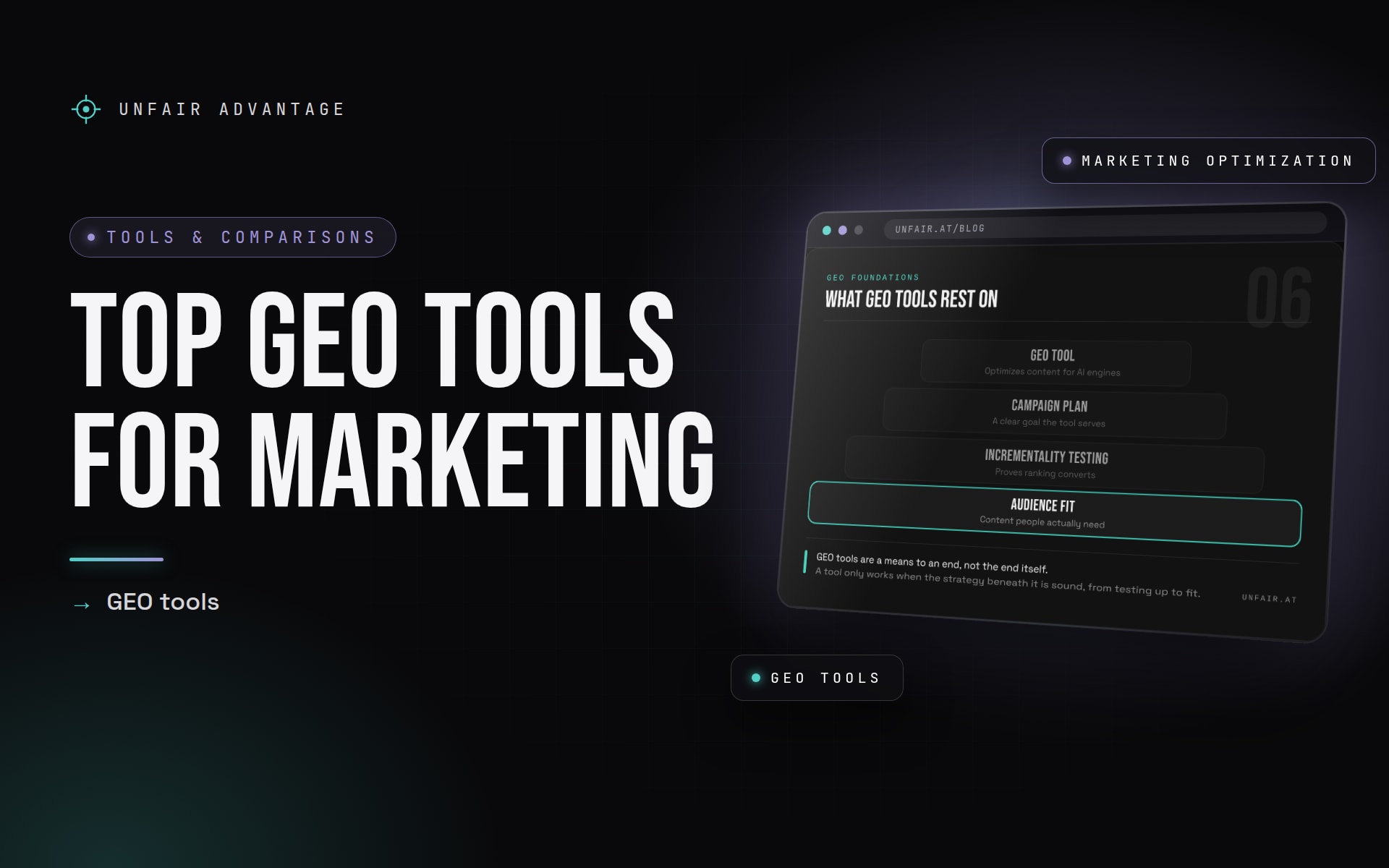
GEO tools optimize your content, but they can’t replace a solid marketing strategy. Pairing them with a clear campaign plan and incrementality testing ensures you’re not just ranking higher but converting better. Learn more in our article on why marketing tools fail without context.
Here’s the thing: GEO tools are a means to an end, not the end itself. If you’re using them without a clear goal, you’re just spinning your wheels. For example, if your goal is to increase trial sign-ups, your GEO strategy should focus on optimizing content that drives that action. If your goal is brand awareness, you might prioritize quotable, shareable content.
The key is to align your GEO efforts with your broader marketing objectives. Otherwise, you’re just optimizing for the sake of optimization.
Automated GEO: Optimization on Autopilot
If you’re tired of manually tweaking your site, consider Automated GEO. This service optimizes your content for AI search engines weekly, ensuring it’s always readable and quotable. It’s the loop we run on unfair.at, and the results speak for themselves.
Here’s how it works: every week, our system scans your site for updates and optimizes it for AI engines. It’s like having a personal trainer for your content: disciplined, consistent, and always pushing for improvement.
But here’s the best part: Automated GEO doesn’t just optimize your content; it also provides a monthly report with actionable insights. This means you can see exactly how your efforts are paying off and adjust your strategy accordingly. It’s optimization made simple.
What’s Next for GEO Tools?
As AI search engines evolve, GEO tools will need to adapt. Expect more focus on conversational analytics and integration with voice search. For now, the key is choosing a tool that fits your needs and pairing it with a solid strategy. Start with a free scan to see where your site stands.
Here’s the bottom line: GEO tools are here to stay, but they’re not a silver bullet. The brands that succeed will be the ones that use them strategically, pairing them with a clear marketing plan and a deep understanding of their audience. So, if you’re ready to take the plunge, start with a free scan and see where you stand. The future of search is here, and it’s conversational. Are you ready?