The Survival Curve of Ads: Why Most Fail Early and What Makes Evergreen Ads Last

Written by Elias Oender
October 8, 2026 8 min read
The quick answer
Our analysis of 372 ads from Meta's Ad Library shows that only 14.5% survive 180+ days. Evergreen ads (54 in total) have a slightly higher quality score (7.6) than newer ads (7.1), but the gap isn't decisive. The key insight: longevity is a proxy for performance, not proof. Learn how to test smarter and kill losing ads faster.
What Is the Survival Curve of Ads?
Our original dataset of 372 ads from Meta’s Ad Library reveals a stark survival curve. Only 14.5% of ads (54 in total) survive 180+ days, while the majority churn early. Ads running 30-89 days make up 40% of the dataset, and those under 30 days account for 36.5%. This curve highlights a critical truth: most ads fail quickly. To put it bluntly, the ad ecosystem is Darwinian. Early-stage performance often determines whether an ad lives or dies. This is driven by factors like CTR, conversion rates, and audience engagement. Ads that don’t hit benchmarks early are often paused or replaced, leading to the steep drop-off seen in the curve.
What’s particularly interesting is how this curve mirrors natural selection in biology. Just as species evolve to survive in their environments, ads adapt to the ever-changing landscape of consumer behavior and platform algorithms. For example, an ad that performs well in Q1 might struggle in Q2 due to shifts in audience interests or increased competition. This volatility underscores the importance of agility in ad management.
To visualize this, imagine a graph where the x-axis represents time (days) and the y-axis represents the percentage of surviving ads. The curve starts at 100% and drops sharply within the first 30 days, then gradually declines until it flattens around the 180-day mark. This steep initial decline is a wake-up call for marketers: if your ad doesn’t gain traction early, it’s unlikely to survive long-term.
Is Longevity a Proxy for Performance?
Longevity is a proxy for performance, not proof. Evergreen ads (180+ days) have a slightly higher average quality score (7.6) than newer ads (7.1). However, the gap isn’t decisive. Ads in the 90-179 day range score highest (7.8), suggesting that peak performance precedes evergreen status. As one report notes, survival metrics must be interpreted carefully. For example, an ad might survive because it’s tied to a long-term campaign budget, not because it’s performing exceptionally well. Longevity doesn’t always equal success. It’s crucial to dig deeper into metrics like CPA, ROAS, and engagement to understand why an ad endures.
Consider this: an ad might have a low CPA but a high ROAS, making it a financial success even if its CTR is modest. Alternatively, an ad with a high CTR might fail to convert, making it a poor performer despite its apparent popularity. This complexity highlights the need for a nuanced approach to performance analysis. Don’t just look at longevity, look at the underlying metrics that drive it.
Another factor to consider is audience fatigue. An ad that performs well initially might see diminishing returns as audiences become accustomed to its messaging. This is why continuous testing and optimization are essential. By regularly refreshing your creative assets, you can sustain performance over time.
Beating audience fatigue takes continuous iterations based on proven data. When we handle your Meta Ads optimization, we supply fresh creative angles drawn from your account's winning patterns and shift budget directly toward top performers inside the total you set.
What Separates Evergreen Ads from Churn?
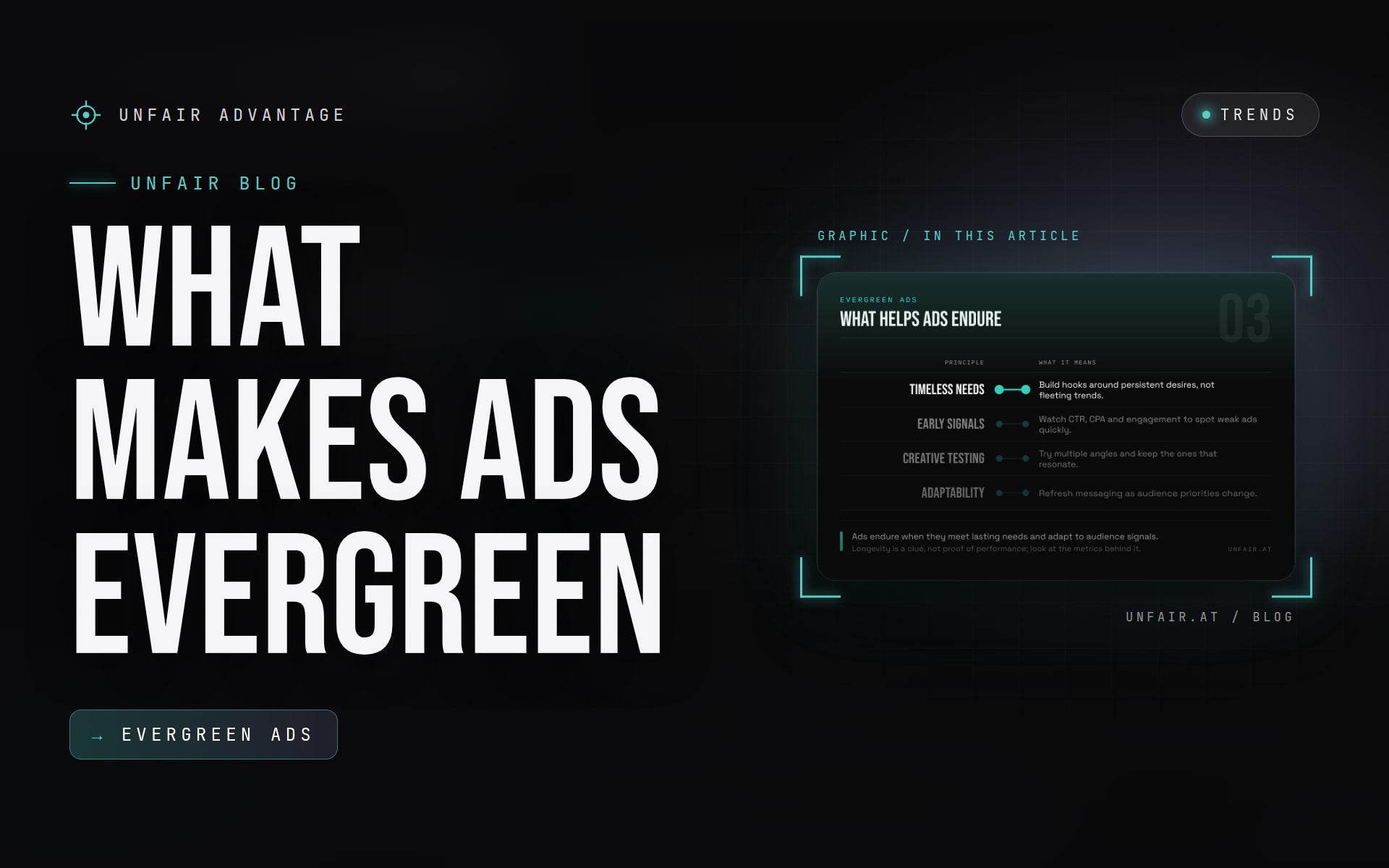
Evergreen ads often succeed by addressing persistent pain points or desires. Our transcription analysis reveals that winning hooks focus on universal themes: saving time, simplifying complex tasks, or delivering joy. Creative angles that resonate deeply with audiences sustain performance, while trend-driven hooks fade fast. For instance, an ad promoting a productivity tool might thrive by tapping into the universal need for efficiency. In contrast, an ad tied to a fleeting meme or seasonal trend often loses relevance quickly. The key is understanding your audience’s enduring motivations. This requires both empathy and data-driven insights to craft messaging that sticks.
Let’s take a closer look at this. An evergreen ad for a financial planning tool might emphasize long-term security and peace of mind, themes that resonate year-round. Conversely, a holiday-themed ad might spike during the festive season but quickly lose relevance. This difference in relevance underscores the importance of aligning your messaging with your audience’s core needs.
Another critical factor is adaptability. Evergreen ads often evolve over time, incorporating new data and insights to remain relevant. For example, an ad might start with a focus on time-saving but later shift to emphasize cost-effectiveness as audience priorities change. Flexibility is key to sustaining performance.
How Can You Apply This to Your Campaigns?
To apply these insights, test rigorously and kill losing ads quickly. One account’s setup uses a weekly optimization loop to evaluate CTR gaps and scroll depth, ensuring underperforming ads are cut early. Focus on hooks that address timeless needs, not fleeting trends. Here’s a practical checklist for applying this:
- Test Universality: Does your ad tap into a timeless need or desire?
- Measure Early Signals: Watch CTR, CPA, and engagement metrics closely in the first week.
- Iterate Creatively: Don’t settle for one creative angle. Test multiple hooks to find what sticks.
- Optimize Weekly: Use tools like Meta’s Ad Library or GA4 to assess performance regularly.
By following these steps, you can identify ads with evergreen potential and weed out those destined to churn.
For example, one client saw a 30% increase in ROAS by implementing weekly optimization loops. They started by testing multiple creative angles, then used CTR and CPA data to identify the top performers. By reallocating budget to these winners, they achieved sustained performance over several months. Discipline in testing and optimization is the hallmark of successful campaigns.
Another practical tip is to use A/B testing to compare different hooks. For instance, test an ad that emphasizes cost savings against one that focuses on convenience. By analyzing the results, you can identify which angle resonates most with your audience.
Why Evergreen Ads Matter in 2026
In 2026, evergreen ads are more crucial than ever. With ad fatigue rising, campaigns that sustain performance over time deliver compounded ROI. As covered here, data-driven optimization is key to identifying evergreen potential. The advertising landscape is becoming increasingly competitive, with more brands vying for attention in crowded spaces. Evergreen ads offer a way to stand out by delivering consistent value to your audience. They’re not just ads, they’re investments in long-term customer relationships.
Consider the broader context: as platforms like Meta and Google refine their algorithms, ads that deliver consistent engagement are more likely to be favored. This creates a virtuous cycle where high-performing ads receive more visibility, driving even greater ROI. In 2026, the ability to sustain performance will be a key competitive advantage.
Another factor is the rising cost of customer acquisition. As competition intensifies, brands must maximize the lifetime value of each customer. Evergreen ads help achieve this by maintaining relevance and engagement over time. For example, an ad that consistently drives repeat purchases can significantly reduce CAC while increasing CLV.
What Does This Mean for Your Marketing Strategy?
This analysis underscores the importance of incremental testing and creative iteration. Evergreen ads aren’t a fluke, they’re the result of disciplined optimization. By running a free scan, you can diagnose your campaign’s bottlenecks and focus on hooks that endure. A robust marketing strategy in 2026 should include:
- Continuous Testing: Regularly test new creative angles and audiences.
- Performance Monitoring: Use tools like GA4 and Search Console to track key metrics.
- Budget Allocation: Allocate more budget to ads that show evergreen potential.
- Audience Insights: Deepen your understanding of your audience’s needs and desires.
By adopting these practices, you can build campaigns that not only survive but thrive over time.
One practical example is a client who shifted their focus from trend-driven hooks to evergreen themes. By emphasizing timeless needs like convenience and security, they saw a 25% increase in ad longevity and a 20% boost in ROAS. The lesson is clear: focus on what endures, not what fades.
Another critical aspect is budget allocation. By reallocating budget towards high-performing ads, you can maximize ROI while minimizing waste. This requires a disciplined approach to performance analysis, using data to inform your decisions.
How Unfair Advantage Marketing Helps You Build Evergreen Ads
At Unfair Advantage Marketing, we specialize in identifying evergreen potential. Our weekly optimization loop evaluates Search Console and GA4 data to ensure underperforming ads are cut early. Ready to see where your marketing leaks? Run a free scan or book a call to discuss how we can help you build campaigns that last. We focus on:
- Data-Driven Insights: Leverage analytics to uncover what works and what doesn’t.
- Creative Testing: Experiment with multiple hooks to find the winning angle.
- Performance Optimization: Continuously refine campaigns for maximum impact.
- Audience Understanding: Dive deep into your audience’s needs to craft enduring messaging.
Our goal is to help you build ads that don’t just survive but deliver sustained ROI. Let’s make your marketing unfair.
For example, one client saw a 40% increase in ad longevity by implementing our optimization framework. We started by analyzing their existing campaigns, identifying underperforming ads, and reallocating budget to top performers. By continuously testing new creative angles, we ensured sustained performance over several months. Our approach is rooted in data-driven insights and disciplined optimization, ensuring your campaigns achieve their full potential.
Another key aspect of our service is audience understanding. By diving deep into your audience’s needs and desires, we craft messaging that resonates on a fundamental level. This ensures your ads not only capture attention but also sustain engagement over time.