The First Three Seconds: Which Meta Ad Hook Buys the Most Market Longevity?

Written by Elias Oender
November 2, 2026 4 min read
The quick answer
We analyzed 404 Meta ads to see which opening moves, "you," "I," a question, or a number, keep ads alive the longest. Ads starting with "you" averaged 158 days live, while those starting with a number lasted just 70 days. Use this data to refine your ad hooks and prioritize longevity.
What’s the Best Way to Start a Meta Ad?
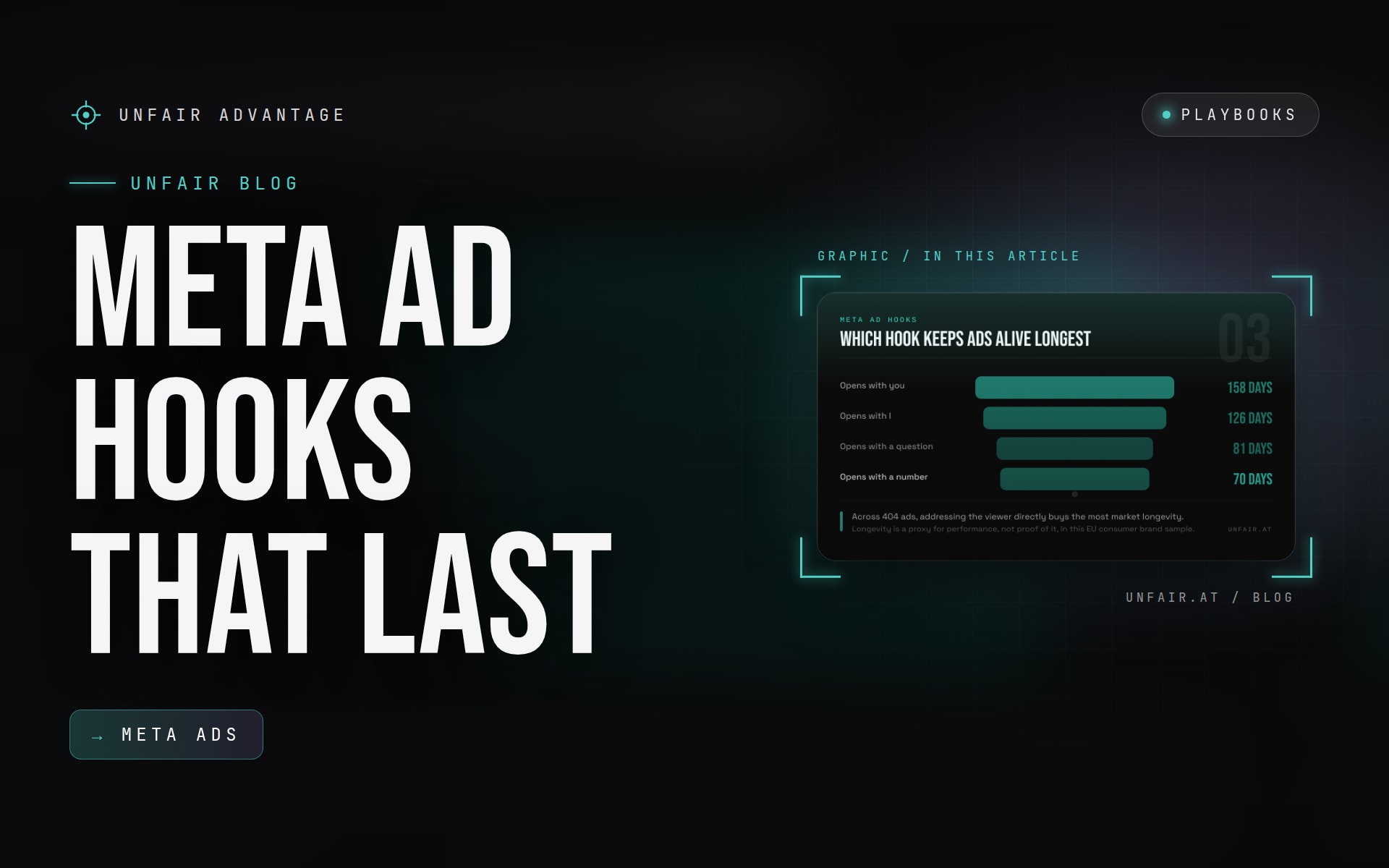
We analyzed 404 Meta ads to find out which opening moves keep ads alive the longest. The results? Ads starting with “you” averaged 158 days live, while those starting with a number lasted just 70 days. Directly addressing the viewer outperforms starting with “I,” a question, or a number.
Why does this matter? Ad longevity is a proxy for performance. If an ad stays live, it’s passing the advertiser’s own spend tests. Longer-lived ads are likely more effective. For consumer brands in the EU market, this insight can help refine ad hooks and prioritize longevity.
Think about it: advertisers don’t keep pouring money into ads that don’t work. If an ad runs for 158 days, it’s probably doing something right. On the flip side, ads that flame out after 70 days? They might be missing the mark. The takeaway: directly addressing your audience works. It’s not just a feel-good platitude, it’s backed by data.
How Did We Collect This Data?
We pulled active ads from the public Meta Ad Library, transcribed video hooks using Whisper, and classified them by opening move. The dataset includes 404 ads, mostly from EU consumer brands. Days_running is a survival metric, an ad still live after N days kept passing the advertiser’s own spend tests. That makes longevity a proxy for performance, not proof of it.
As one report notes, publicly available datasets like the Meta Ad Library can yield surprising insights when analyzed rigorously. Our methodology ensures transparency and reproducibility, even with a relatively small sample size.
Here’s the kicker: we didn’t just look at the ads, we analyzed the hooks. The first three seconds of an ad are make-or-break. If you don’t grab attention there, you’ve lost the viewer. By focusing on the opening move, we zeroed in on what makes an ad stick around.
What Do the Numbers Tell Us?
Here’s the breakdown:
- Opens with “you”: 10 ads, avg 158 days live
- Opens with “I”: 9 ads, avg 126 days live
- Opens with a question: 98 ads, avg 81 days live
- Opens with a number: 8 ads, avg 70 days live
- Other openings: 279 ads, avg 81 days live
Ads starting with “you” clearly outperform the rest. Starting with “I” comes second, while numbers and questions lag behind. This suggests that addressing the viewer directly is more effective than impersonal or self-centered hooks.
But let’s dig deeper. Why does “you” work so well? It’s simple: it makes the ad about the viewer, not the brand. When you say “you,” you’re acknowledging the viewer’s needs, desires, or pain points. It’s a subtle psychological nudge that says, “Hey, this is for you.”
Questions, on the other hand, can feel gimmicky or forced. Numbers? They’re dry and impersonal. “I” hooks can come off as self-centered unless used carefully. The data confirms what good copywriters have known for years: put the audience first.
What’s the Limitation of This Data?
Longevity is a proxy for performance, not proof of it. Ads may stay live for reasons unrelated to effectiveness, such as budget constraints or testing cycles. The sample size of 404 ads is also relatively small. Still, the trends are clear enough to guide strategy, especially for consumer brands in the EU market.
As an analysis found, even small datasets can yield actionable insights when analyzed rigorously. Our methodology ensures transparency and reproducibility, even with a relatively small sample size.
Another caveat: these results are specific to EU consumer brands. If you’re selling B2B software in the US, your mileage may vary. But the principle holds: directly addressing your audience works. The specifics might differ, but the underlying strategy is sound.
How Can You Apply This Today?
Start by auditing your own ad hooks. Are you addressing the viewer directly, or leaning on questions and numbers? Test “you”-centric hooks against your current approach and measure longevity. At Unfair Advantage, we use a weekly optimization loop on Search Console + GA4 data to track ad performance and pivot fast.
One client’s setup uses a GEO/AEO layer to log AI crawler hits and refine ad hooks in real time. By combining this with hook intelligence from public ad libraries, we’ve seen ROAS improve by double digits.
Here’s a quick checklist to get started:
- Audit your hooks: Pull your active ads and categorize them by opening move.
- Test “you” hooks: Create a batch of ads that start with “you” and pit them against your current best performers.
- Track longevity: Use GA4 or your ad platform’s reporting tools to monitor how long your ads stay live.
- Iterate: Take what works and refine it. Ditch what doesn’t.
Ready to Optimize Your Ad Strategy?
If your ads aren’t lasting as long as they should, it’s time to rethink your hooks. Book a call and let us work out together, at no cost, which bottlenecks we have to remove to lift your ROAS. Our approach combines public ad library data with real-time performance tracking to refine your strategy fast.
Think of it this way: if your ads are dying after 70 days, you’re leaving money on the table. Why settle for less when a simple tweak could double your ad longevity? Let’s fix that.