Google Marketing Live 2026: Is Gemini Running Your Ads, or Just Running You?

Written by Elias Oender
March 30, 2026 4 min read
The quick answer
At Google Marketing Live 2026, the company rebuilt its ad stack around Gemini, introducing features like Business Agent for Leads, Ask Advisor, and Asset Studio. While these tools promise speed and automation, advertisers risk losing control and transparency. This piece examines the trade-offs: what you gain in efficiency, what you quietly lose in oversight.
Google Marketing Live 2026: Is Gemini Running Your Ads, or Just Running You?
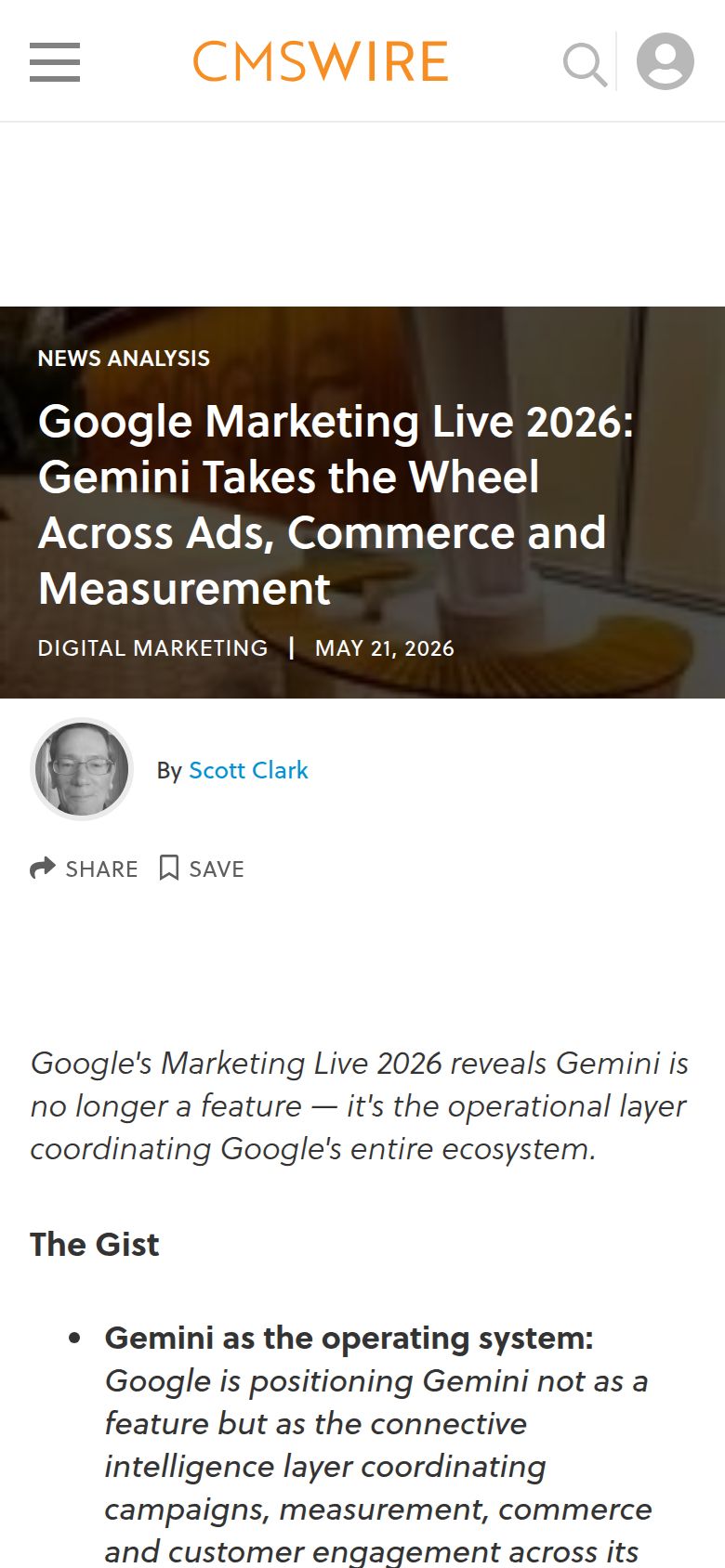
At Google Marketing Live 2026, the company made one thing clear: Gemini is now the backbone of its ad stack. From Business Agent for Leads, a chat interface that submits pre-filled lead forms, to Ask Advisor, a unified assistant across Ads, Analytics, and Merchant Center, Google is betting big on AI-driven automation. But as advertisers, we need to ask: is this good for us, or just good for Google? as covered here
What’s New in the Gemini-Powered Ad Stack?
Google’s announcements at Marketing Live 2026 were a mix of incremental upgrades and bold innovations:
- Business Agent for Leads: A Gemini-powered chat that interacts with users directly in the ad, grounding its responses in your site and submitting pre-filled lead forms. First testing in education, automotive, and real estate.
- Ask Advisor: One AI assistant that spans Google Ads, Analytics, Merchant Center, and the Google Marketing Platform.
- Asset Studio: Build campaigns from a written brief, powered by Gemini.
- Smart Bidding Exploration: Expanded to Performance Max and Shopping campaigns.
- Promotion Mode: A beta feature for automating promotional campaigns.
These tools promise to save time and streamline workflows, but they also raise questions about control and transparency.
What Do Advertisers Gain?
Handing more of your funnel to Gemini comes with undeniable benefits:
- Speed: Campaigns can be built and optimized faster than ever. Asset Studio, for example, turns a brief into a full campaign in minutes.
- Efficiency: Ask Advisor consolidates insights across platforms, reducing the need to juggle multiple dashboards.
- Personalization: AI-powered Shopping ads write custom explainers per product, potentially improving engagement.
But speed and efficiency come at a cost.
What Do Advertisers Lose?
The trade-offs are subtle but significant:
- Transparency: With Smart Bidding Exploration and Business Agent for Leads, it’s harder to trace why decisions were made. Why did Gemini prioritize one lead over another? Why did it bid a certain amount? These answers are often opaque.
- Control: Automation reduces manual oversight. While this can save time, it also means less ability to intervene when something goes wrong.
- Customization: One-size-fits-all AI tools may not align with your unique business needs. For example, Asset Studio might generate campaigns that don’t fully capture your brand’s voice.
Is This Good for Google, or Just Good for Google?
Let’s be honest: Google’s pivot to Gemini isn’t just about helping advertisers. It’s about locking them into its ecosystem. The more you rely on Gemini, the harder it becomes to switch platforms or even understand your own data. And with Meta projected to overtake Google in global ad revenue for the first time in decades, Google needs to differentiate itself. an analysis found
But differentiation shouldn’t come at the expense of advertiser autonomy. As ChatGPT, Perplexity, and other AI search engines grow, with 31.3% of the US population expected to use generative AI search in 2026, Google’s move feels both timely and self-serving.
What Should Advertisers Do?
Here’s how to navigate the Gemini-powered ad stack:
- Test Wisely: Use features like Business Agent for Leads and Asset Studio in controlled experiments. Measure their impact on key metrics like ROAS and CPL.
- Demand Transparency: Ask Google for more visibility into how Gemini makes decisions. Push for explainability in AI-driven actions.
- Retain Control: Use Gemini as a tool, not a replacement for human judgment. Keep manual checks in place, especially for high-stakes campaigns.
- Diversify Platforms: Don’t put all your eggs in Google’s basket. Explore Meta’s AI connectors or other platforms to reduce dependency.
The Bottom Line
Google’s Gemini-powered ad stack is a double-edged sword. It offers speed and efficiency but risks eroding advertiser control and transparency. As we embrace AI-driven marketing, let’s remember: automation should empower us, not replace us. Run a free scan to see how Gemini impacts your campaigns, or book a call to discuss how to balance automation with oversight.
For more on AI marketing, check out how to improve ROAS with AI in 2026 or why your ROAS number might be lying. And if you’re curious about Meta’s AI innovations, read how Meta passed Google in ad revenue.