Why Did Only 11% of Enterprises See AI Revenue Growth?

Written by Elias Oender
November 13, 2026 3 min read
The quick answer
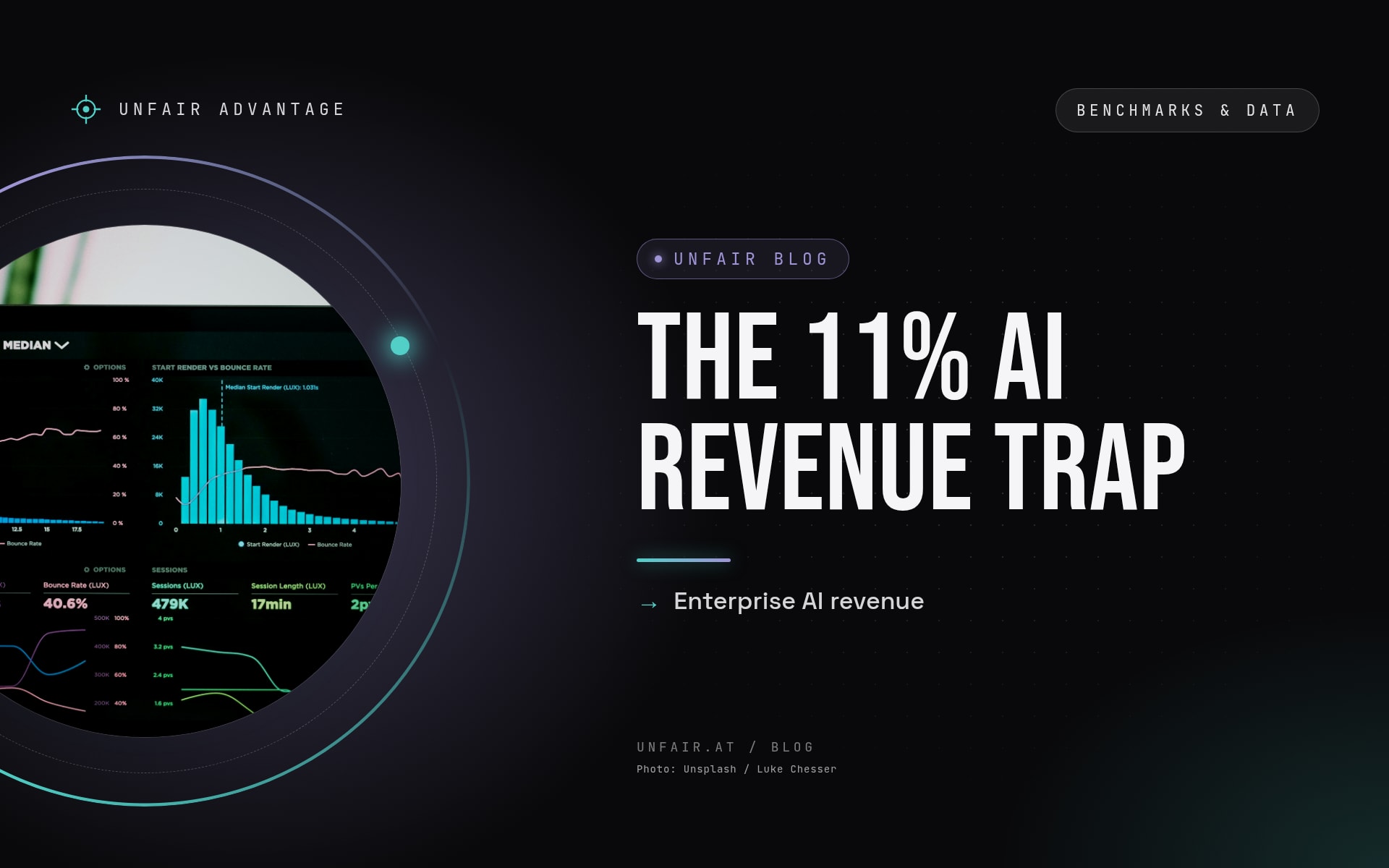
A Harvard Business Review Analytic Services survey revealed that only 11% of enterprises saw actual revenue growth from AI investments. Bolting autonomous tools onto legacy funnels merely automates existing pipeline friction. Real commercial lift requires structural workflow changes and dedicated senior oversight rather than agency headcount or bloated tool stacks.
A Harvard Business Review Analytic Services survey recently delivered a necessary cold shower to corporate boardrooms: exactly 11% of enterprises saw actual revenue growth from their AI deployments. The remaining 89% bought subscriptions, distributed logins, and produced pitch decks explaining how transformative the technology would be by next quarter. Predictable.
Most enterprise AI adoption resembles installing a jet engine onto a golf cart. You do not get to orbit; you just tear the axle off faster. When go-to-market teams bolt autonomous agents onto messy CRM data and vague target accounts, they do not create demand. They simply accelerate friction across the pipeline. This pattern explains why marketing tools fail without context and why throwing software licenses at broken attribution models changes nothing.
What are AI marketing tools actually automating in your funnel?
When a pipeline leaks, automating it simply turns a steady drip into a firehose of wasted effort. Software vendors promise that agentic workflows eliminate human error. Instead, they democratize bad judgement at machine speed. Research on the enterprise AI trust gap shows that leadership enthusiasm collapses the moment executives inspect what autonomous systems actually deliver.
- Synthetic outbound volume: SDR teams launch automated outreach that floods inboxes with boilerplate sequences, burning domain reputation in weeks.
- Fragmented conversion metrics: Algorithms chase cheap, low-intent clicks to hit cosmetic goals, compounding why your ROAS number lies in 2026.
- Bloated internal reviews: Marketing managers spend Friday afternoons auditing robotic hallucination rather than talking to buyers.
Over 15+ years in performance marketing, I have seen every technology cycle repeat this exact delusion. Teams assume tools create strategy. My systems do the opposite: code handles execution while human logic enforces discipline. When you automate a flawed process, you get automated waste.
Why does a dedicated senior operator beat agency layers?
The corporate instinct to counter poor AI performance is hiring an agency to manage the sprawl. That trades one bottleneck for three. You swap an autonomous tool that does not understand your product for an agency account manager who hands your brief to a junior coordinator behind closed doors. You pay enterprise retainers to fund layer upon layer of agency overhead.
Real performance requires technical clarity, not headcount. At Unfair, Elias runs performance infrastructure directly. One senior operator armed with tested AI systems outperforms twelve agency coordinators because there is zero translation loss. In past engagements across 72 clients, that lean posture delivered an average conversion lift of +127%. I wire custom systems like Ad Infinitum to dynamically shift ad budgets to commercial winners without agency meetings or delayed approvals.
Everyone says AI. Nobody owns the plan?
Executive teams keep buying generative tools while commercial pipelines remain completely flat. If you want results instead of pilot projects, AI marketing consulting builds the commercial roadmap directly on your verified unit economics, priced from €1950 / month. I run the strategy and wire autonomous agents into your data architecture myself, bypassing bloated agency rosters entirely. You can book a 15-minute call to map your pipeline, or run a free scan right now to audit your technical baseline. Automating broken operations wastes cash; engineering structural leverage prints it.