

Running Arabic and English Ads Side by Side in the UAE: Strategy and Measurement

Written by Elias Oender
November 13, 2026 10 min read
The quick answer
Running Arabic and English ads side by side in the UAE requires separate campaign architecture, localized creative hooks, and clean incrementality testing. Treating the UAE as a single English-first market leaves high-intent Arabic demand untapped, while basic machine translation burns ad spend. Success comes down to splitting language delivery by intent and isolating true pipeline value rather than blended platform metrics.
A common mistake in Dubai media planning is treating the United Arab Emirates as a homogenous, English-first sandbox. Marketing managers open an ad account, set the geography to Dubai and Abu Dhabi, check the English language box, paste copy that worked in London or Singapore, and congratulate themselves on hitting their target CPM. Two weeks later, customer acquisition costs blow past internal limits, sales teams complain about pipeline quality, and finance questions the quarterly budget.
Then comes the classic overcorrection: run the exact same English creative through an online translation tool, upload Arabic headlines into the same ad set, and let the algorithm sort it out. The result is budget cannibalization, confused algorithmic delivery, and ad spend vanishing into cheap, low-intent clicks. Operating as a performance practitioner in the UAE requires understanding that the linguistic split between Arabic and English is an operational problem with distinct consumer mechanics.
What does go to market strategy mean for bilingual UAE campaigns?
The UAE market is demographically split between an English-speaking expatriate majority and a deeply influential Arabic-speaking base of Emiratis, long-term GCC residents, and Levant or North African professionals. If your commercial go-to-market plan relies entirely on English, you are ignoring a buyer segment with immense purchasing power. Conversely, if you treat Arabic as a mere translation project, your messaging will fail to convert. Local nuances, mainland trade parameters, and distinct consumption patterns across the emirates require tailored positioning.
Running dual-language media effectively requires understanding intent. Expat communities in free zone commercial hubs interact daily in English, browsing corporate sites, international SaaS tools, and expat lifestyle offerings in that language. Meanwhile, Arabic media consumption often dominates family decision-making, local retail banking, high-value real estate inquiries, and regional municipal services. The debate about language strategy is addressed in an analysis by NVM, which highlights that pitting Arabic directly against English is the wrong way to look at MENA media; the split must follow user context and category intent.
+-------------------------------------------------------------+
|                 UAE BILINGUAL ACCOUNT ARCHITECTURE          |
+-------------------------------------------------------------+
| [CAMPAIGN: EN - High-Intent Commercial]                     |
|    ├── Ad Set A: English Copy + Western Hooks               |
|    └── Ad Set B: English Copy + Subcontinent Hooks          |
|                                                             |
| [CAMPAIGN: AR - Native Localized Conversion]                |
|    ├── Ad Set A: Modern Standard Arabic (Gulf Tone)         |
|    └── Ad Set B: Visual-First Short-Form Video (Arabic Audio)|
+-------------------------------------------------------------+
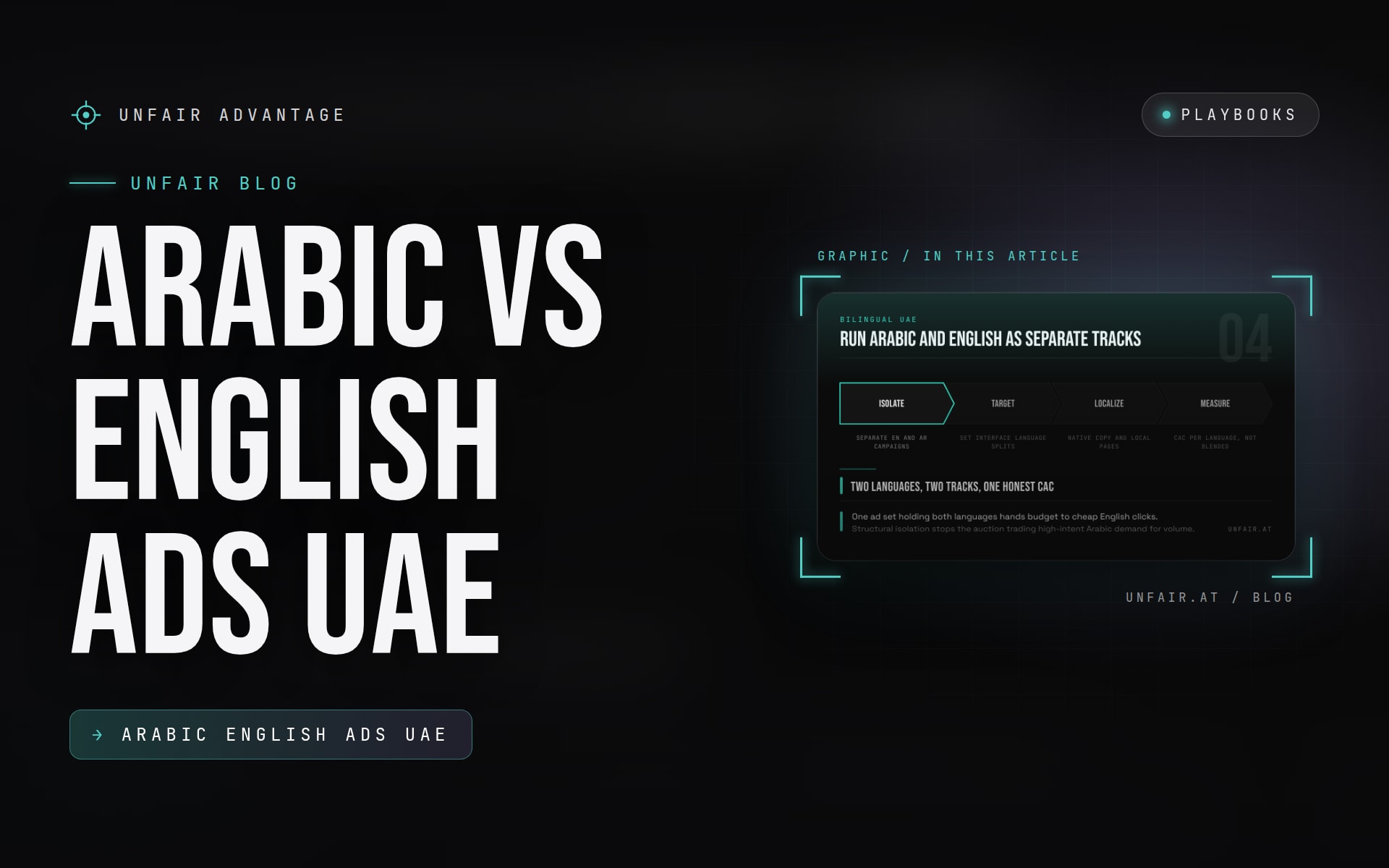
When brands push both languages into a single campaign, the ad auction algorithm defaults to whichever ad generates the cheapest immediate impression, usually dragging budget away from higher-intent Arabic segments toward high-volume English inventory. That immediate efficiency is an illusion. To capture regional demand, you must structurally isolate language tracks from the start.
How to go to market strategy with clean audience separation?
If you want your bilingual campaigns to scale, never rely on Meta or Google to balance languages inside the same ad group. You need strict account architecture. In my work running ad systems for clients across competitive markets, letting platforms guess creative intent without strict controls reliably inflates acquisition costs. You can see where your marketing leaks by auditing campaign isolation and cross-device conversion signals before committing fresh capital.
Audience overlap is the biggest pitfall in Gulf media delivery. In the UAE, bilingual users frequently browse apps with their operating system set to English while conducting personal transactions in Arabic, or vice versa. Discussions on community boards like this Reddit thread on Gulf ad delivery repeatedly expose the headaches of unsegmented bilingual ad groups cannibalizing identical prospect pools. To solve this, your baseline targeting framework must enforce strict linguistic boundaries:
- Interface language splits: Build separate campaigns for English and Arabic. When building Arabic campaigns, target users whose app language or browser preference is explicitly set to Arabic to prevent platform drift.
- Creative language matching: Ensure that Arabic ad copy directs users solely to fully localized landing pages. An Arabic ad leading to an English checkout drops conversion rates instantly, driving up cost per acquisition.
- Exclusion mechanics: Explicitly exclude converting cohorts and established remarketing lists across parallel campaigns so English retargeting ads do not bid against your Arabic top-of-funnel sets.
- Placement tailoring: Direct visual-heavy Arabic lifestyle creatives to mobile placements (Instagram Reels, TikTok, and YouTube Shorts), while keeping text-heavy English thought leadership campaigns focused on desktop and LinkedIn.
Splitting your budget across clean campaign boundaries prevents the platform from taking the path of least resistance. You gain visibility over your actual customer acquisition cost per language, making scale predictable.
What is marketing automation when applied to bilingual creative testing?
Creative translation is the graveyard of Gulf ad spend. Direct transliteration produces stiff, awkward phrasing that native speakers instantly scroll past. For example, direct translations of common Western promotional idioms fail to resonate during regional shopping moments like Ramadan, Eid, or White Friday, where cultural tone and family priorities shape consumer action.
Real creative localization involves testing three distinct elements simultaneously: visual assets, linguistic framing, and commercial calls to action. Research by Conquerra Digital UAE on bilingual ads shows that balancing modern visual pacing with culturally grounded Arabic copy yields significantly stronger engagement than direct visual reuse. On the creative side, you must treat Modern Standard Arabic and regional Khaleeji phrasing as distinct stylistic tools depending on whether you are selling enterprise software in Dubai Internet City or luxury villas in Abu Dhabi.
Testing these assets manually in spreadsheets creates immediate operational friction. Cost per acquisition keeps climbing, and marketing teams end up guessing why performance tanked. In my client work, addressing this breakdown is central: ad optimization provides monthly Google, Meta, and Microsoft Ads management where a dedicated senior audits campaigns, rebuilds tracking structures, and shifts spend to proven winners, with plans starting from €1950 per month. Rather than hiring a layered agency with junior coordinators, having a single operator with AI systems ensures that campaign anomalies and localized creative fatigue are caught and fixed immediately.
When testing creative variations, evaluate how regional payment preferences alter your funnel metrics. In the UAE, conversion behavior shifts drastically based on whether you offer Apple Pay, local debit cards, or Cash on Delivery (COD). Arabic-language campaigns often see high top-of-funnel interest, but if your checkout does not support fast, trusted regional payment rails, drop-offs accelerate at the final step.
How do you read results when bilingual audiences overlap?
Attribution in a bilingual environment is messy. A user in Sharjah might discover your product through an Arabic video ad on their personal mobile feed, research the company on a desktop browser configured in English while at work, and finally purchase via an English search ad. If you evaluate your media mix using basic in-platform reporting, your search campaigns will claim 100% of the credit, while the Arabic awareness campaign looks like an expensive failure.
Relying blindly on blended metrics obscures performance. Over-crediting last-click conversion touchpoints leads directly to bad budget allocation, a systemic risk explored in our breakdown of why your ROAS number lies in 2026. To measure performance accurately across language variations, you need clean incrementality testing and isolated conversion tracking.
+-------------------------------------------------------------+
|                 BILINGUAL ATTRIBUTION REALITY               |
+-------------------------------------------------------------+
| Day 1 (Mobile - Personal):                                  |
| User views native Arabic TikTok / Reel ad (Impression)      |
|                                                             |
| Day 3 (Desktop - Office):                                   |
| User searches brand name via English Google Search (Click)  |
|                                                             |
| Day 4 (Mobile - Personal):                                  |
| User converts via direct URL with Apple Pay                 |
|                                                             |
| PLATFORM VIEW: English Search gets 100% conversion credit.  |
| OPERATOR VIEW: Arabic top-of-funnel opened the pipeline.    |
+-------------------------------------------------------------+
When evaluating lead generation campaigns, look beyond cost per lead (CPL). An operational study by Big Red Digital on Gulf CPL dynamics notes that while Arabic lead forms often show lower initial costs, down-funnel qualification rates vary dramatically by industry. If your sales representatives cannot respond in Arabic within minutes of inquiry submission, lead value evaporates. High-intent regional buyers expect immediate, native-language follow-up over phone or WhatsApp, not a delayed email sequence written in English.
To keep performance clear, assign distinct conversion tags, tracking pixels, and CRM pipelines to your Arabic and English funnels. Do not pool inquiries together into one generic sales queue. Monitor cost per qualified opportunity by language segment rather than overall blended cost per acquisition. If you need clarity on your local conversion pipeline, book a call to review your tracking infrastructure.
Which ki tools für marketing actually solve multilingual performance?
Marketers frequently ask which AI tools can automate localized paid campaigns across the Gulf. Software platforms that claim to autonomously generate, translate, and deploy bilingual ad suites generally create more chaos than value. Standalone tools lack market context, often producing translated copy that is technically accurate but commercially lifeless.
Software alone does not fix broken positioning. We explore this dynamic in our critique on why marketing tools don’t work alone. Successful marketing automation is not about subscribing to ten disconnected SaaS platforms; it requires building integrated, repeatable pipelines. When I run AI workflows across high-volume accounts, AI handles high-speed data parsing, query filtering, and script automation, while strategic framing and local creative direction remain firmly operator-led.
As Thomas Jäger, Project Lead at youEngineering AG, puts it:
“With Elias from Unfair, you get to strong results quickly and with focus. What makes working with Elias special: all marketers talk about data, Elias actually applies it.”
True marketing efficiency in the UAE comes from linking ad platforms to real-time inventory and CRM data. Using script-based automation to shift spend between English and Arabic campaigns based on sales team capacity, current inventory, or regional conversion spikes protects margins far better than generic translation tools. Automation should handle operational tasks so the operator can focus on strategy.
What are marketing tools without incrementality testing in the Gulf?
Scaling paid acquisition in Dubai without testing incremental lift leads to waste. As spend scales past 100,000 AED per month, platforms inevitably take credit for sales that would have happened organically through brand affinity or physical retail footprint. The danger of running media without control groups is examined in our guide on why playbooks fail without incrementality.
To prove that your Arabic and English campaigns are generating net-new revenue rather than claiming existing demand, run geographic or audience-holdout tests. Take comparable emirate-level audiences, such as specific commercial areas of Dubai versus Sharjah, and run pure English campaigns in one segment while running synchronized bilingual campaigns in the other. Compare the blended revenue lift across both cohorts over a four-week cycle.
+-------------------------------------------------------------+
|              GEOGRAPHIC INCREMENTALITY TEST (UAE)           |
+-------------------------------------------------------------+
| Cohort A (Control Segment):                                 |
| - Geography: Abu Dhabi / Expat Commercial Districts         |
| - Strategy: English Campaigns Only                          |
| - Baseline Metric: Cost Per Qualified Pipeline Sale         |
|                                                             |
| Cohort B (Test Segment):                                    |
| - Geography: Dubai & Northern Emirates Commercial Hubs      |
| - Strategy: Isolated English + Native Arabic Side-by-Side   |
| - Evaluation: Incremental Pipeline Lift vs Cohort A         |
+-------------------------------------------------------------+
If the bilingual cohort shows a clean, statistically significant increase in closed-won deals at an acceptable customer acquisition cost, you have established your incrementality multiplier. You can then scale ad spend into that structure with confidence, insulated from misleading in-platform attribution and vanity engagement metrics. The goal is to build an acquisition system that reliably turns AED spend into realized pipeline revenue.