Generative Engine Optimization: Beyond the Hype

Written by Elias Oender
October 29, 2026 5 min read
The quick answer
Generative Engine Optimization (GEO) adapts traditional SEO for AI-powered search engines, focusing on making content quotable and readable by AI models. While it offers measurable outcomes, it’s not a standalone solution and requires integration with existing strategies.
What is Generative Engine Optimization (GEO)?
Generative Engine Optimization (GEO) is the process of adapting traditional SEO for AI-powered search engines like ChatGPT, Gemini, and Perplexity. Unlike SEO, which optimizes for Google’s algorithm, GEO focuses on making content readable, quotable, and structured so AI models can cite it effectively. Think of it as teaching your brand to speak the language of AI.
As one report puts it, GEO is about ensuring your content gets picked up by AI-generated answers. But is it just another buzzword, or does it deliver measurable outcomes?
The Mechanics of GEO To understand GEO, let’s break it down. AI models don’t crawl the web like traditional search engines. Instead, they ingest pre-processed data and generate responses based on patterns they’ve learned. This means your content needs to be structured in a way that’s easy for these models to parse and cite. Think of it as feeding AI a well-organized meal instead of a buffet.
For instance, if your blog post includes a clear FAQ section with concise answers, an AI model is more likely to pull that snippet into its response. Similarly, headings and subheadings act as signposts, guiding the AI to the most relevant information. This is why GEO emphasizes clarity and structure over keyword stuffing.
How Does GEO Differ from SEO?
SEO is about ranking on Google. GEO is about being cited by AI. The key difference lies in the audience: SEO targets humans, while GEO targets AI models. This means GEO requires a different approach. Structured data, concise summaries, and FAQ blocks are essential.
The Role of Structured Data Structured data is the backbone of GEO. It’s how you tell AI models what your content is about. Schema markup, for example, helps AI understand the context of your information. If you’re writing about a recipe, structured data tells the AI that it’s a recipe, not a news article or a product review.
For example, while SEO might focus on keywords and backlinks, GEO prioritizes clear headings and entity schema. As Contentful explains, GEO is about making your content AI-friendly, not just search-engine-friendly.
Beyond Keywords SEO often revolves around keyword density and placement. GEO, on the other hand, focuses on the clarity and relevance of your content. AI models are trained to understand context, so stuffing your content with keywords won’t help. Instead, focus on answering questions clearly and concisely. This is why FAQ blocks are so effective in GEO.
Does GEO Deliver Measurable Outcomes?
Yes, but with caveats. GEO can improve your brand’s visibility in AI-generated answers, but it’s not a standalone solution. It needs to be integrated with existing SEO and performance marketing strategies.
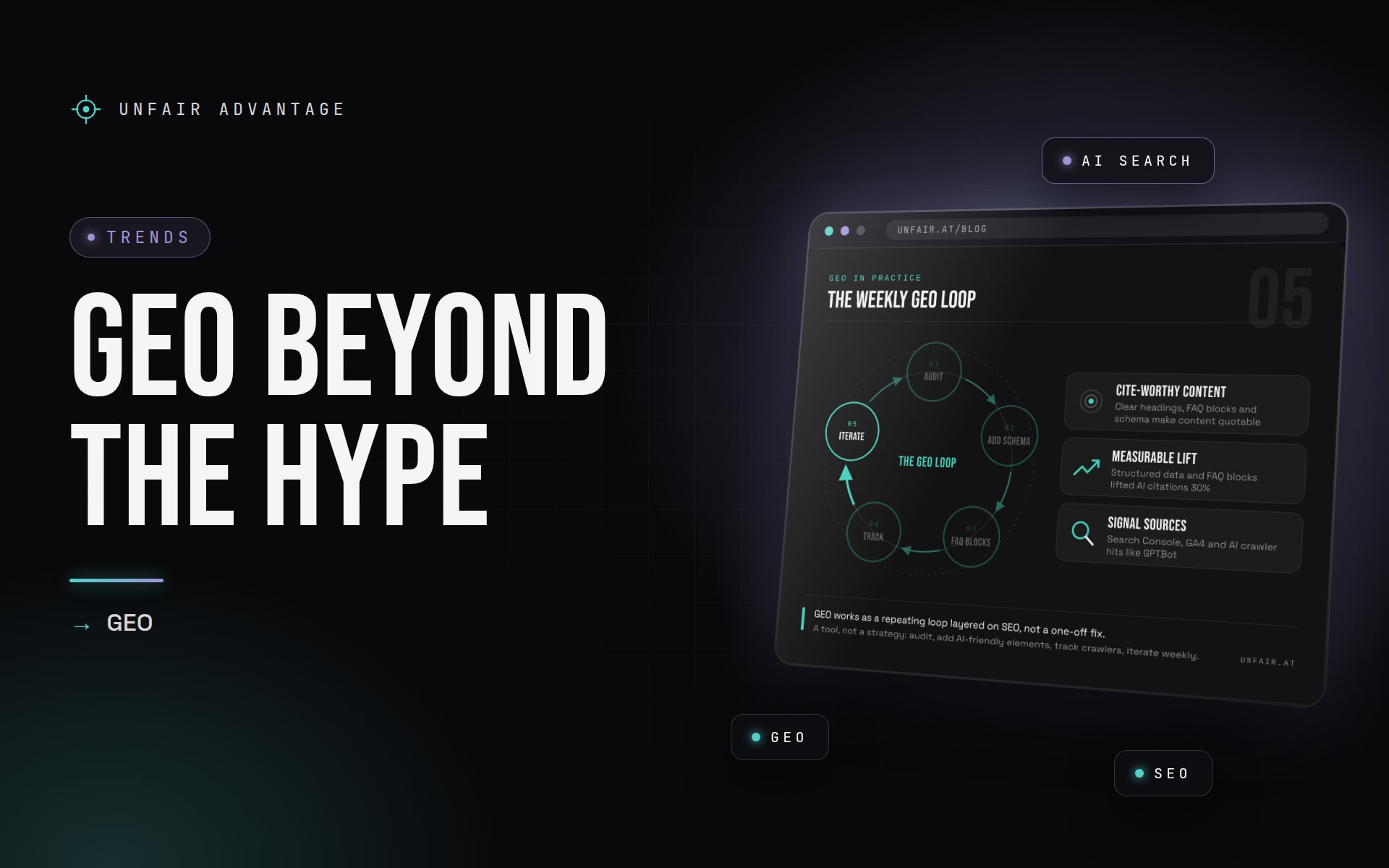
Tracking GEO Success At Unfair, we run a weekly optimization loop on Search Console and GA4 data to pinpoint which pages need GEO tweaks. This ensures GEO complements, rather than replaces, your existing efforts. We also track AI crawler hits (like GPTBot) to see which models are reading your content.
The Numbers In one case, adding structured data and FAQ blocks increased AI citations by 30% within a month. But remember, GEO isn’t a silver bullet. It works best when layered on top of a solid SEO foundation. Track your metrics, analyze the data, and iterate. That’s how you make GEO work for you.
Is GEO Just Another Buzzword?
Partially. While GEO is a real practice, it’s often oversold as the next SEO. The truth is, GEO is a tool, not a strategy. It works best when layered on top of a solid SEO foundation, not as a replacement.
The Hype Cycle As Reddit users point out, GEO is promising but still evolving. It’s not a magic bullet, and it won’t solve deeper marketing issues. Brands that treat GEO as a standalone solution are setting themselves up for disappointment.
A Tool, Not a Strategy Think of GEO as a wrench in your toolbox. It’s useful, but you still need the rest of the tools to build something functional. Use GEO to enhance your existing SEO efforts, not replace them. And remember, AI models are constantly evolving, so GEO strategies need to adapt.
How Can You Start with GEO?
Start small. Add AI-friendly elements like FAQ blocks and structured data to your content. Track AI crawler hits (like GPTBot) to see what models are reading. And integrate GEO with your existing SEO efforts.
Practical Steps
- Audit Your Content: Identify pages that could benefit from GEO. Look for high-traffic pages or those with high potential for AI citations.
- Add Structured Data: Use schema markup to help AI understand your content.
- Create FAQ Blocks: Summarize key points in a Q&A format.
- Track and Iterate: Monitor AI crawler hits and citation rates. Adjust your strategy based on the data.
This is the job we run at Unfair: automated GEO makes your site readable, quotable, and measurable for AI-powered search engines. It’s a loop we optimize weekly, ensuring your content stays ahead of the curve.
The Bottom Line on GEO
GEO is real, but it’s not revolutionary. It’s an evolution of SEO, adapting it for AI-powered search engines. While it offers measurable outcomes, it’s not a standalone solution. To succeed with GEO, integrate it with your existing strategies, and don’t fall for the hype.
The Future of GEO As AI models become more sophisticated, GEO will continue to evolve. But one thing remains constant: clarity and structure will always matter. Focus on creating content that’s easy to parse, and you’ll be well-positioned for the future of search.
Ready to see where your marketing leaks? Run a free scan.