Why Swapping ABM for AI Content Engines Burns Your Pipeline

Written by Elias Oender
November 11, 2026 3 min read
The quick answer
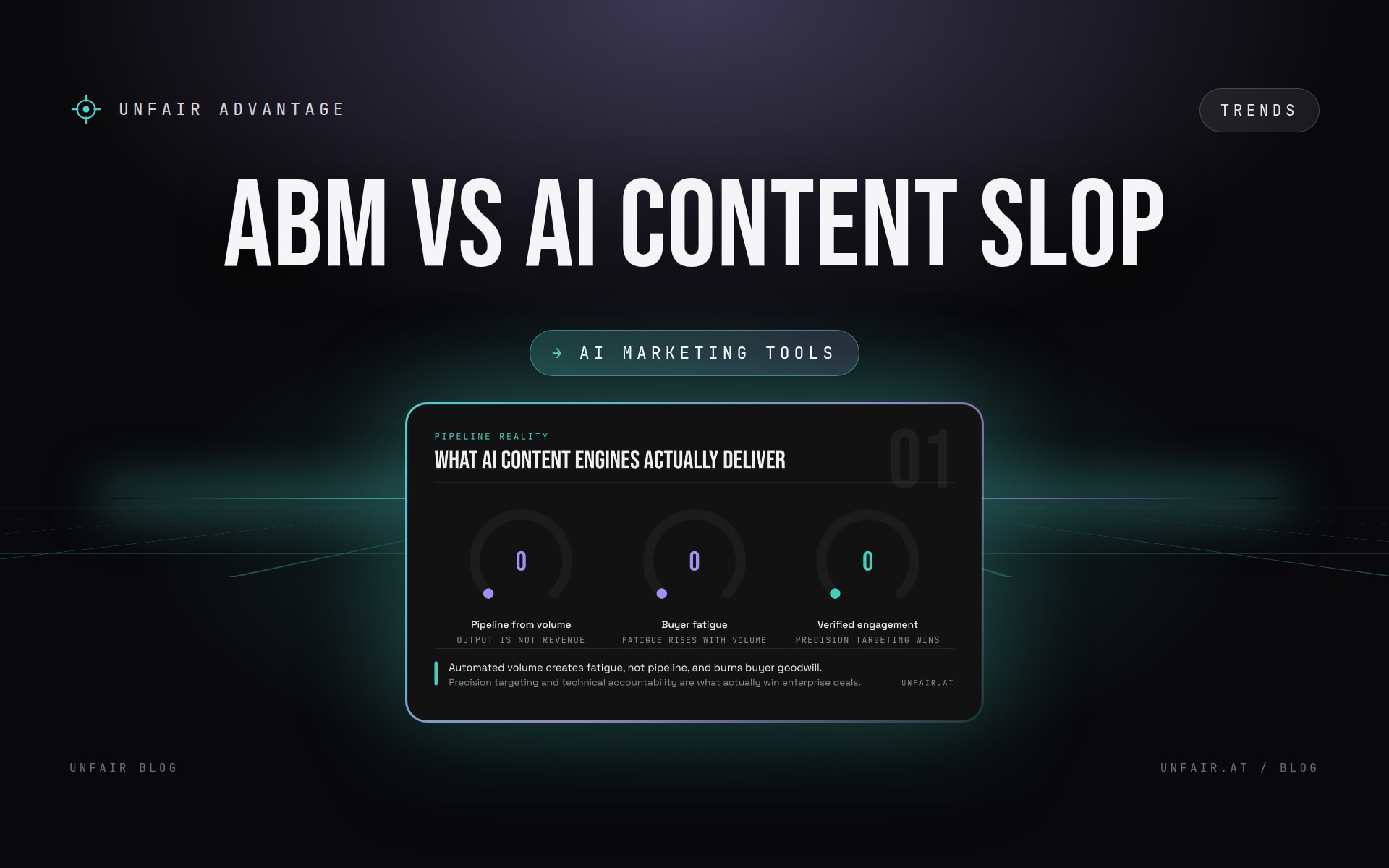
Swapping disciplined Account-Based Marketing (ABM) for generative AI content engines does not solve an empty pipeline. Flooding prospects with uncalibrated AI text burns your domain reputation and ignores real intent data. Real B2B pipeline growth comes from tightly targeted positioning run by a dedicated operator, not automated volume.
Every few quarters, B2B leadership discovers a shiny shortcut to bypass tough sales conversations. In 2026, boardrooms are eagerly ditching coordinated Account-Based Marketing in favor of autonomous generative engines. The pitch is predictable: replace expensive targeting with software that churns out thousands of personalized articles, whitepapers, and cold sequences. The result is pure digital exhaust. Diluting verified account intelligence into automated noise fixes nothing. It simply scorches your buyer goodwill and sends your corporate domain into deliverability purgatory.
What is AI marketing tools hype doing to your pipeline?
Flooding inboxes with automated synthetic drafts does not create pipeline. It generates fatigue. When companies sacrifice disciplined account targeting to chase sheer output, they ignore fundamental buyer behavior. As noted in one analysis of growth drivers, real revenue acceleration relies on structured buyer engagement, not undifferentiated volume. You cannot spam an enterprise buying committee into signing a multi-year deal.
In my own client setups over 15+ years, I strip away these bloatware stacks entirely. As Elias runs performance systems, the focus stays on precise demand capture rather than automated filler. For Swisscom, this meant a dedicated B2B growth play targeting verified decision-makers on LinkedIn to win buyers at a lower cost, delivered with The Relevent Collective. In performance systems, why marketing tools don’t work alone boils down to a lack of commercial context. Unchecked volume burns trust before an SDR even dials.
Welche KI Tools für Marketing actually protect your domain?
The market wants push-button miracles, but industrial spam triggers immediate platform penalties. Email providers and enterprise firewalls ruthlessly flag machine-generated patterns, dragging hard-earned domain authority down. Real technical leverage looks entirely different:
- Intent-driven paid distribution: Transcribing public competitor libraries to build tighter message angles instead of generic outbound copy.
- Algorithmic budget allocation: Routing ad spend dynamically toward verified conversion branches with a mathematical floor for testing.
- Answer-engine readiness: Implementing structured entity schema and
llms.txtso modern search models cite your brand cleanly.
Running content through uncontrolled generative loops ignores why marketing tools fail without context. In my client workflows, creative angles run as parallel test branches with strict scale, test, or kill verdicts weighted by an EWMA of conversions. Losing angles lose budget within weeks. You protect your reputation by moving ad spend strictly to proven commercial winners, not by broadcasting unvetted AI monologues.
What are marketing tools worth without a senior operator?
Agencies love selling 12-person teams to run automated tooling, billing extra margin for every layer of account management. You do not need five junior coordinators babysitting an AI tool that spams your market. You need one senior operator who understands unit economics and controls the architecture.
In our client accounts, conversions are split into hard milestones like verified calls versus soft vanity clicks, preventing automated runs from skewing reality. When industry benchmarks show where modern growth strategy actually works, precision targeting and absolute technical accountability always win out. If you want to identify where your marketing engine leaks cash, see where your marketing leaks or book a call to build an unfair advantage.